




Cool: Fridge Without Using Electricity!
This is incredible idea is an extension of the pottery water cooling vessels used though the millennia.
Chris Gupta
Cool: Fridge Without Using Electricity!
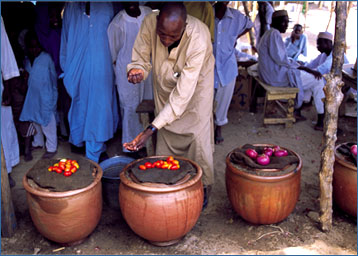
This is Mohammed Bah Abba's Pot-in-pot invention. In northern Nigeria, where Mohammed is from, over 90% of the villages have no electricity. His invention, which he won a Rolex Award for (and $100,000), is a refrigerator than runs without electricity.
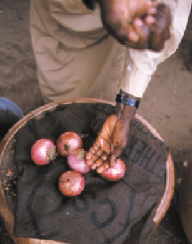
Here's how it works. You take a smaller pot and put it inside a larger pot. Fill the space in between them with wet sand, and cover the top with a wet cloth. When the water evaporates, it pulls the heat out with it, making the inside cold. It's a natural, cheap, easy-to-make refrigerator.
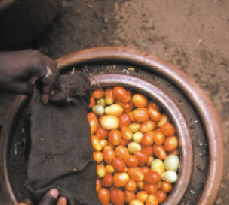
So, instead of perishable foods rotting after only three days, they can last up to three weeks. Obviously, this has the potential to change their lives. And it already has -- there are more girls attending school, for example, as their families no longer need them to sell food in the market.
Arnold Williams from hathaby.net commented on this in his weblog. He said:
QUOTE
Brilliant ideas don't need to be difficult to execute: here's a case in point. The technology has been known for centuries, but WASN'T APPLIED TO THE PROBLEM. Notice that applying technology also has the effect of educating young people.
posted by Chris Gupta on Wednesday April 14 2004
updated on Saturday September 24 2005URL of this article:
http://www.newmediaexplorer.org/chris/2004/04/14/cool_fridge_without_using_electricity.htm
Related ArticlesBreakthrough Power:
"How quantum-leap new energy inventions can transform our world" by Jeane Manning & Joel Garbon is a non technical and easy to understand book that contains a fantastic summary of "free energy*" devices. The authors have done a superb job of making this difficult and somewhat esoteric information accessible to all. Both the experienced and those new and/or starting out in this exciting area of research will find the... [read more]
December 14, 2010 - Chris GuptaCaution About Compact Fluorescent Lighting (CFL)
Yes further to: Sunlight, Lighting And Your Health (Dangers Of Fluorescent Lighting). With the exponentially increasing toxins in the environment adding mercury spill from fluorescent bulbs is simply unacceptable. Chris Gupta See also: Communities In Bloom Goes Environmentally To The Dark Side The message below will advise you about one problem concerning the use of compact fluorescent bulbs. You should also be aware that many of these bulbs contribute to... [read more]
May 02, 2007 - Chris Gupta"Population Reduction" -- Or Change Of Paradigm?
"Many writers have spoken of intentional plans by certain Elite to thin-out the world's population; it's a recurring theme among so-called conspiracy theorists. There are frequent references to "useless eaters", which includes the bulk of mankind. Most, when hearing of plots to depopulate the planet, simply say under their breath, "Yeah, right," or more often, while shaking their head, "You're nuts." But when there is a careful examination of writings... [read more]
November 05, 2006 - Chris Gupta
Readers' Comments
GREAT
Posted by: Barry Groves on April 14, 2004 02:16 PM
GREAT
Posted by: Kevin Loebach on September 7, 2004 04:12 AM
Evaporative coolers like this are dependent on aridity for greatest cooling. In an arid (dry) climate, placing a wet cloth over what you want to cool keeps the item 50-60 degrees farenheight, but anywhere that you get a chill from wearing a wet shirt will do.
Posted by: D. Ray Stranahan on November 7, 2004 12:27 AM
I came across this website and they claim to have the answer to running your car on hydrogen on demand. I would like to know if anyone is doing this or just none sense? The site is http://educate-yourself.org/fe/fewaterasfuel28jan02.shtml
Also has anyone heard about the Joe cell? Does it work?
Posted by: max on April 5, 2005 03:19 AM
Re Teslas experiments with high voltage very short pulse trains, could you tell me the voltage used and the On/Off ratio of the pulses? Also, for .1 microsecond duration pulses, obviously a rotational switch is impractical. What method of switching was used?
Posted by: Steele Braden on September 13, 2005 09:35 PM
GREAT
Posted by: OKPALA GILBERT on September 25, 2006 04:08 PM
Its a pot! worthy of a $100,000 dollar prize? I dont think so
Posted by: Filepromptdotcom on April 2, 2008 06:59 PM
This technique was used by the No Impact Man when they were shutting off their electricity. It apparently worked well for them. For the modern American, it would be a huge shift from what we're used to, but in poorer countries like nigeria, it's perfect
Posted by: Charles Forster on April 3, 2008 08:25 AM
Patronising prize for existing evaporative cooling device. If this was designed by a european everyone would laugh. I used a superior water based evaporative refrigerator as a child. The fact it uses local pots and sand in a water wasting, less effective manner makes it kosher for the greenwash brigade. Spend the money on the real Nigerian scientists looking at malaria that haven't even got reliable power for their real refrigerators. Not stunts like this. Just ask yourself this question with any technology. "If its not good enough for you, why should two pots and a bucket of sand be OK for them"
Posted by: Waldo Hitcher on April 3, 2008 05:38 PM
I'm shocked, that's an ancient 'invention', it was NOT created by that man. It's great they're using it/promoting it...but they did not invent it.
Posted by: Marian on April 4, 2008 03:42 AM
Wow.That last guy was angry. This would sure be good enough for me! But, I live in a cool temperate climate: would it work here? Also, how is it maintained? Do you just keep adding water to it? Is faster or slower evaporation more effective? I am going to make one and find out. And why was that last guy so angry? Worried about greenwash and malaria and crappy electricity supplies. Ok I get that. Still, it would be a shame to underestimate the power of self-suffiency. I would love to know more about the superior water based evaportative cooler Waldo used as a child.
Posted by: littlewren on April 4, 2008 09:15 AM
RE: Waldo Hitcher: It may seem silly, but it seems to me that this device, though simple, would in fact be very useful to share with countries such as Nigeria, where it was developed. It seems simple to us, but unless you independently invent it, how are you supposed to know that putting a pot in another pot filled with wet sand will give you a refrigerating device? This publicity will hopefully give way to an educational movement on the technique, and it seems that it has become widely known if it's been making an impact on girls going to school. I did find the article vague on that point, though. Also, the problem of water in Nigeria is not that there isn't enough of it; it's that there isn't enough potable water. I'm sure waste water, such as from washing, would be suitable in this application. Furthermore, I don't think it's reasonable to expect that all Nigerians could afford more advanced solutions, such as the one you knew as a child. The pot method seems primitive, but it's better than the alternative, and affordable: a winning combination. If I had a choice between my food spoiling and having to use a primitive refrigerator, well, I'd take the pots.
Posted by: Cinnabar on April 5, 2008 12:44 AM
Absolutely without taking anything away from this ingenious invention, note these: 1) In Iran, city of Yazd, evaporative cooling has been used for centuries to keep houses cool in scorching summers. Google it but in short: tall air catchers, air entering underground water wells, losing heat, then entering homes). Very organic. Cranes love to nest on the tall wind catch towers. 2) Clay jars cooling drinking water by evaporative cooling since clay allows water to seep out through the clay wall thickness and the process of evaporation cools the water inside.
Posted by: Farzan on April 5, 2008 11:39 AM
Don't forget that in Muslim countries, the wind towers in their buildings provide free air conditioning.
Posted by: Super Mike on April 6, 2008 10:39 PM
I believe that this type of a 'fridge' has been used in India for AGES. Instead of keeping the smaller pot inside a larger pot, they dig the smaller pot inside sand itself. The sand is then kept wet. Works well under shade in sunny areas and in deserts.
Posted by: Abisurd on April 7, 2008 05:29 AM
These ideas have been in use since ages, i would assume this must have been the ealiest forms of cooling and lost its sheen as technology developed artifical and quicker methods for the process. however thinking of it impacting a community in a profound manner so much so as to getting girls going back to school is an absurd co-relation. what cant we look at in exoensive practical tools/equipemts which are in line with modernity and at the same time reduces the gap in technology between those have access to high end technology and them to those who dont. but telling people to use this method as the perfect alternative to cooling/refrideration is tunnel vision. i am sure developed and progressive nations have a better way of brining about education and provision amond the lesser developed and impoverished nations. (for example electricity generated out windmills could power an electric fan to hasten the cooling process around the pots or a portable refriderator of this kind be made with some modern technology would be something we should look in to instead of sending people back in time only to go further back)
Posted by: Dave on your face on April 16, 2008 10:43 AM
Great stuff, and glad to see people talking about things to help those in need.
Posted by: David @ The Good Human on April 16, 2008 03:01 PM
So did this Nigerian guy patent his invention? He gonna get any money of people making them? Follow up question how cold does it get? Funny ha ha cold or "oh I can actually safely store my food without having diarrhea tomorrow" cold?
Posted by: Amadeus on April 19, 2008 02:14 PM
Am I missing something here? That "invention" would not keep anything contained within it more than a few degrees cooler than the ambient outdoor temperature. Evaporation in that arrangement is not going to do much at all. So maybe the food goes from rotting in 3 days to rotting in 3.5 days. Big deal.
Posted by: robert paulson on April 20, 2008 08:19 PM
Wow! To think that the answer for a cheap refridgerator was here all the time . . . Although, it doesn't seem likely it would really keep it cool. Huh, not much of an invention really. Just a bucket of sand.
Posted by: Luna on April 26, 2008 07:29 PM
I spoke with a elderly missionary couple who had used a different, but equally interesting cooling device. It consisted of two metal balls filled with some sort of refrigerant, maybe ammonia?. The two balls were connected by a small tube. They would place one end in the cooking fire, which turned the refrigerant into a gas and forced it into the other ball. Later, they would place that other ball in a "cool box" and as the refrigerant phase changed throughout the day back into the other ball, it took all the heat out of the cool box. They were able to make ice even.
Posted by: Doug on May 6, 2008 09:36 AM
Same idea used in the Aussie outback (although it was more a box draped in wet hessian) called a Coolgardie Safe or Cooler till kero fridges became affordable.
Posted by: Marc on May 8, 2008 02:31 AM
lt's things like this that show the ingenuity of mankind, unless of course he merely imported the idea from somewhere else.
Posted by: Kelvin on May 9, 2008 12:28 PM
If you have no cooling at all then this is an inexpensive step upward. Don't knock something that helps someone who has nothing.
Posted by: wally on May 26, 2008 10:12 AM
its a great invention by the nigerian
Posted by: uddi on May 27, 2008 06:53 AM
Simple, easy, and who cares if it's been for years in some other countries, it's a great idea! It's Rolex's money and they can do what they want
Posted by: Brett Holt on May 30, 2008 02:41 AM
Hey, we are the manufacturer of cooler box in China, any interest, plz contact with me with my MSN or Email: xurrycn@hotmail.com
Posted by: Xurry on June 4, 2008 03:43 AM
great idea. If I show poor people that leave in extreamly hot places (100+ degrees)how to apply this method of cooling and it makes their lives just a bit better GREAT!!!!
Posted by: jorge on June 23, 2008 11:47 PM
And when someday we'll be ALL sitting in the dark without any electricity.
When you are wondering what to do with that gluttony of refrigerated food so it won't spoil before the electricity comes back on,remember this.
You moron's believe the majority of the world's population have modern conveniences,when in actually they live close to the situation this family does.Posted by: Lathrop Wells on July 10, 2008 10:30 PM
I studied and improved this concept substantially in my first design class with a few of my class mates. It really turned out well, but I don't know of how to let others implement our improvements. http://rickywillems.myrpi.org/potinpot.html
Posted by: Ricky Willems on August 11, 2008 02:15 AM
I'm appalled by all the negative comments. Nobody is making any claim of this pot-in-pot being able to compete with modern gas or electric refrigerators when it comes to maintaining a constant ideal temperature. And perhaps it is based on a principle known from ancient times, and not Abba's own original idea, but the man did put two and two together, and what he came up with is a system that actually works for the people it is intended for. People who have precious little money or food were heretofore unable to keep food fresh for any significant length of time, but thanks to Abba's pot-in-pot system, shelf life of their food has been greatly extended. Certainly a less-than-perfect refrigerator is much better than none at all, no? I would say the man deserves a great deal of credit and praise.
Posted by: Child of Gaia on August 24, 2008 09:13 PM
CHECK THIS OUT: "intermittent absorption refrigeration" does not use electricity. originally invented/discovered by Ferdinand Carre in 1858. Adam Grosser recently got the thermodynamics unit at Stanford to analyse the concept and discovered that the standard refrigeration tables (for ammonia) were wrong. With a design team from the UK, he designed and built a safe unit using low pressure, non-toxic coolants. The current prototype: an 8 lb refrigeration unit is heated (ie over a fire) for 1/2 hour, then let cool for an hour, then inserted it into a large 3 gallon storage drum. It keeps the drum at just above freezing for 24 plus hours. They will cost 25 to 40 dollars, and can be used to preserve medicine as well as food, anywhere hot that lacks electricity. http://www.youtube.com/watch?v=HSdXqmnNCp0 p e a c e
Posted by: baron morris on November 8, 2008 10:52 PM
Great idea. It is crazy juts how ingenious yet simple some ideas can be. Why not expand upon ideas like this that are eco friendly and use no electricity.
Posted by: pays to live green on November 13, 2008 09:05 PM
WOW, this is wonderful!! They should use these here in america. It could save us all a lot of money now that our country is in a recession.
Posted by: Mattress on November 21, 2008 10:52 AM
what a fantastic invention nice
Posted by: cooler choice on December 13, 2008 08:18 PM
Note to haters in 2009: If you can't say something positive, then say nothing. After this last storm in Houston, people with no transportation or cooler could have used this information because ice was unavailable. Be glad for your blessings!
Posted by: Sheronda Cooper on January 5, 2009 03:07 AM
Yes, it is not 'new' technology, but what is? If it works in the relevant climate it is good. @Doug - the missionary ball refrigerator that used ammonia (R717) was probably a cousin of the 'Icyball' kerosene powered refrigerator (see Google) and indeed all modern gas powered refrigerators. For solar powered refrigeration (and a closer relative of the missionary system) see the 'ISAAC icemaker' and its variants which also use an ebb-and-flow cycle.
Posted by: BenM on April 28, 2009 02:58 PM
VERY GOOD
Posted by: JJB on July 2, 2009 07:20 AM
This is very cool. I want a giant one. ha. Really though, it's awesome that its helped children be able to go to school.
Posted by: Lauren on November 28, 2009 11:28 PM
In the '30s, the gas evaporator refrigerator used a pilot light to boil the liquid, it was condensed in the finned unit on top. Substitute the gas pilot light with a convex (dome) Fresnel lens to boil the liquid using sunlight. All else stays the same. Painted white, it could sit in the sun to cool down during the daytime - made ice too. This idea should be in public domain, as all parts are in use for other purposes. Keep door closed during the night to preserve the refrigerated interior.
Posted by: Robert Chamberlin on November 29, 2009 04:13 PM
I learned to do this in the Boy Scouts in the early 90's. We did it at summer camps to keep drinks cold. I am not impressed.
Posted by: Eric M on November 30, 2009 09:30 PM
How the hell did this guy win an award for this? This is such an old trick! I heard of this before the Internet was even invented. That's what you have to do apparently. "Invent" something that's been around for hundreds or thousands of years and pretend that it was your design. Pathetic.
Posted by: OHHkay... on December 2, 2009 05:53 PM
While I think this is a great idea, it is also a pretty old idea and has been used for a long time. Still, I have to admit, it's very clever.
Posted by: solar panels for sale on December 7, 2009 10:34 PM
I love all things ecological/economical and recently looked into how refrigerators work and if it would be possible to make one without electricity... came up with a similar idea to this, then found on the internet that it's already existed in 3rd world countries for donkeys years! Rock on I say! Us westerners rely on electricity and fossil fuels far too much. If only they would invent electricity-free computers, phones and internet I would give it up altogether! :-D Re: some of the more negative posts: Just because we have electric fridges/ovens/technology in the west does not make us superior or more intellegent, it just makes us more dependant! We use these appliances every day but how many of us would actually know how to make one from scratch out of raw materials? Stick one westerner, and one person from a so-called developing country on a desert island together, and who do you think would better know how to survive? If the power went out for a month all over the world, WE'D be the only ones running round in the dark in a panic searching for candles in the basement with meat going off in the "fridge"! lol ;-)
Posted by: Wilykit104 on December 10, 2009 12:41 PM
Good idea whether passed on from earlier enertions or not! In many areas of the world the temperature 10 feet below ground is a constant 55 degrees. This has also been put to good use by many generaions.
Posted by: JB Johnson on December 27, 2009 09:04 PM
Not entirely a new concept but it is a great idea and helpful to those in need.
Posted by: solartronenergy on August 28, 2010 08:06 AM
May God Bless Mohammed Aba Nabba.I've modernized the Design. And I'll make it my lifes carreer.
Posted by: Dr Joe on January 20, 2011 08:34 AM
I salute Prof. Mohammed Abbah for his wonderful pot-in-pot .I've modernized the design to suite everybody anywhere.And I'm ready to train all Rural people worldwide,women in particular so as to reduce poverty,hunger and unemployment. Engr.Joe Okeke(Dr) 26 ziks Avenue,Awka-NIGERIA 234-08064305190
Posted by: Engr Okeke Joe on February 4, 2011 04:55 AM
Mr. Joe okeke,
Sir, Even I hav made modernized the same theme pot cooling, in big size for helping farmers to store the yield, like tomatoes, potatoes, and other fruits, while transfering from fields to market.
You know i have designed with small inner pipes with a coolant - 5 volts motor. and a continous water revolving whole container made up of Clay.
Even my design has-
a see through transperent Glass Door,
Some Shelves inside,
and alarm for demand of water, if water level decreases.
( just like a normal rectangular, refrigerator.Even i have sketch of mini van with shelves and Walls - made of total earthen clay, mud, sand, sponge, small stones, cocnut fibre.
This will be very helpfull for poor farmers, to there necessity.Even i have a commercialized design with modernisation, equpments, running with solar pannels.
I am a govt. lecturer in India. i am willng to do this innovative as my dream project.
and also i have some other Ideas.If you accept, i am willing to work with you.
my contact:
vinod Kumar, +91 9247745007.
vinodkumar_bio@yahoo.comPosted by: vinod kumar on February 8, 2011 02:24 AM
Many thanks Mr Vinod Kumar.We can all work together and reduce poverty,hunger and unemploymentworldwide.More greese to your elbow. Engr.Joe Okeke joenewideas@yahoo.com
Posted by: Engr.Joe Okeke[Dr] on April 7, 2011 12:39 PM
Like the man said its not a new idea its simply been applyed to a problem and with great results so hell yeah EPIC WIN here.
Posted by: solar hot water Peter on July 5, 2011 05:26 AM
This truly goes to show that anything is possible. We dont NEED all of the luxuries we are blessed to have.
Posted by: Paige @ Green Global Travel on February 17, 2012 01:04 PM
I'm inviting Mr Vinod Kumar of India to Nigeria for us to jion hands for this wonderful invention to save the poorest people world over.It's a TASK THAT MUST BE DONE,NOW.
Dr.Joe Okeke.
234-08064305190Posted by: Dr.Joe Okeke on May 21, 2012 11:37 AM
It is genuinely an superb and helpful product or service of details.
I am pleased that you basically distributed this useful details with us.
Please keep us advising like this. Thanks for talking over.Posted by: Air Conditioning Service Alexandria on October 26, 2012 06:16 AM
I am inviting all that concern with the reduction of hunger,poverty and unemployment worldwide to join hand to mass produce this green fridge with us.I thank Prof.Mohammed Aba and Vinod Kumar for interess.I am ready to train rural women/youths world on this technology.I can train on solar dryers,solar incubators and solar oven production to save the entire women globally.
Posted by: Dr Joe Okeke on February 6, 2013 07:58 AM
i must salute Prof.Mohammed,the inventor of green fridge.i must give kudo to Vinod Kumar from India fo the follow up.Now I am calling all 3rd World women where energy is still a big issue to call me for SKILLS ACQUISITION TRAININGS to master the production of green fridge and overcome FOOD WASTAGE FREE.
Dr Joe Okeke live in Awka,Anambra state Nigeria.234/08064305190Posted by: Dr Joe Okeke on February 27, 2013 07:35 AM
very nice & good invention....
Posted by: sneha biradar on August 28, 2013 08:56 AM
Seems like a pretty good idea for 3rd world countries.
Posted by: Green Iowa Energy on January 7, 2014 11:42 AM
really great idea, but i think it's not a new one. Although it seems to have really good results... thanks you! :)
Posted by: lifeadvancer on November 21, 2014 05:57 AM
|
|
 |
||
|
A Person Is Only As Valuable As She Can Be Of Help To Others |
|
|
||

This work is licensed under a Creative Commons License.
These articles are brought to you strictly for educational and informational purposes.
Be sure to consult your health practitioner of choice prior to any specific use of any of the non drug device or food based medicinal products referenced herein.


