




Antidepressants - Drugging kids in school
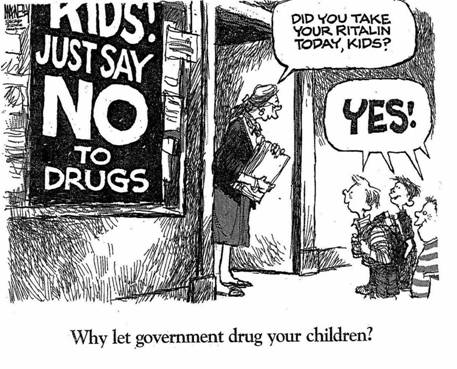
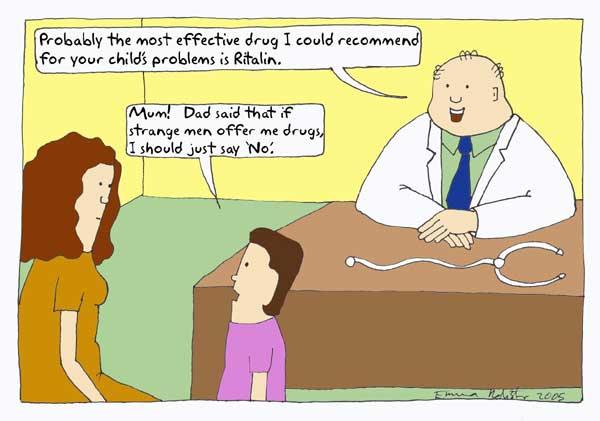
Attention deficit hyperactivity disorder or ADHD, is a custom-made "disease" to start selling drugs quite legally to school kids. Have the doctor prescribe them. Your kid will be that much better off - or not?
It appears that the real dough about the adverse effects of antidepressant drugs has been kept secret so as not to ruin sales. Violence and suicide are common side effects of those drugs, and there are some who say that just about every major school shooting has been commited by a kid on psychiatric drugs.
It is time we stopped rooting for the profits of pharmaceutical companies, even if they do make up much of the national economy of several countries, and started thinking about the health of our children and their future lives. (Just a hint for legislators...)
Jenny Thompson of the Baltimore Health Sciences Institute has put the story together in a very easy-to-follow way, and what's best - she gives us an idea of what natural alternatives to use.
Update April: Added an interesting discussion of the drugging-kids issue by Jon Rappoport at the end of the article.
Update 18 April 2005: Advocates Protest the Drug Industry's "Take Over of the Mental Health System."
Representatives of mental health and consumer advocacy groups from throughout the USA will hold a peaceful protest and press conference in front of the headquarters of the Pharmaceutical Manufacturers and Researchers of America (PhRMA). Protesters allege that, "The drug industry has taken over the mental health system. And we want it back."
MindFreedom International is sponsoring the legal protest at 12 noon on Monday, May 2, 2005 at PhRMA; 1100 Fifteenth Street, NW; Washington, DC, USA.
Image credit: Emma Holister
Minor Concerns
Health Sciences Institute e-AlertFebruary 11, 2004
*****************************************
Dear Reader,"A complicated web of money, emotion, science and regulation."
That's how a reporter for National Public Radio (NPR) described the recent hearing conducted by an FDA advisory panel, convened to examine the negative effects that antidepressant drugs have on children.
No comment was expected from the panel until summer. So it came as a surprise when the panel issued a statement last week recommending that warnings are needed immediately to elevate the level of concern for doctors who might prescribe antidepressants to treat young patients.
But any doctor who's not already concerned - who hasn't been aware, for instance, of the disturbing number of young people who have committed suicide while taking these drugs - simply hasn't been paying attention.
-----------------------------------------------------
Secret keepers
-----------------------------------------------------Last October, the FDA issued a warning that doctors should be cautious in prescribing selective serotonin reuptake inhibitors (SSRIs, such as Prozac, Paxil and Zoloft) to children. The warning cited the possibility that SSRIs may be linked to suicides when taken by patients under the age of 18.
Then in December, regulators in the UK issued a warning that SSRIs may be unsuitable for children because of an estimated 3.2 percent increased risk of suicide among children who take these drugs. The warning also revealed that several negative studies of SSRI effects on young patients have been withheld from publication.
This supposed revelation was referred to as a "smoking gun" by some, but no one who's familiar with the drug approval process is surprised. When drug makers conduct trials in preparation for an FDA review, they routinely withhold studies that could be damaging - submitting only the studies that would encourage FDA approval. This is their right under the current system. They fund all of the research, so they can keep any study secret if the results would negatively affect a pending approval.
The problem with this system is obvious: When negative results are withheld, doctors may end up prescribing a drug without knowing about some of the associated problems. But because SSRIs are such popular drugs, their effects on children have also been researched in government-funded studies. And according to a report on NPR, analysts have found that government studies are far more likely than industry-funded studies to conclude that antidepressants may not work well for children.
Show of hands: Is anyone really shocked by this?
------------------------------------------------
Safe alternatives
------------------------------------------------An FDA analysis of available SSRI studies involving children suggests that more than 100 subjects experienced suicide-related behaviors.
Advocates of SSRI use in children (and there are many) say that the number of suicides by users of the drugs are offset by the number of kids who would commit suicide without the drugs. But this argument only holds water if you completely ignore the natural alternatives to treating depression.
Prescribing drugs to address depression has become so common that the idea of giving SSRIs to kids makes perfect sense to doctors with pharmaceutical tunnel vision. Apparently, most of them never imagine that nutritional changes can often provide effective treatment for depression in young and old alike.
In the e-Alert "Omega Delta Blues" (10/28/02), I told you how those who experience mild to moderate depression often find relief with an increased intake of omega-3 fatty acids (in fish or fish oil supplements). And people who are depressed are often deficient in magnesium, which is found in whole grains, nuts and leafy green vegetables. Herbal supplements like valerian root, chamomile, black cohosh, and rosemary may also help manage depression. And the standout among the herbs for mild to moderate depression is, of course, St. John's wort, which is sometimes called the "natural Prozac" for its apparent ability to help manage the proper functioning of seratonin in the brain.
High levels of B vitamins have also been shown to relieve symptoms of depression. In addition to supplements, good dietary sources of vitamin B are: tuna, salmon, avocados, bananas, mangoes, potatoes, broccoli, cauliflower, poultry and meat. Note that stress (which often goes hand in hand with depression) is believed to deplete the body's store of B vitamins.
If you're the parent or grandparent of a child who's struggling with depression, I urge you to explore the dietary and supplement options before you choose to medicate with a powerful drug whose effects in children have been studied, but not completely revealed.
To start receiving your own copy of the HSI e-Alert, visit this page:
To start digging deeper, here are a few pointers:
A great ADHD page: The Block Centerhttp://www.alternet.org/story/20594/
AlterNet - Here, Kiddie, Kiddie - By Kelly Hearn - Posted on November 29, 2004
For Gene Haislip, a former official of the U.S. Drug Enforcement Agency, the perennial debate over Ritalin, the stimulant commonly prescribed for children with "attention deficit hyperactivity disorder (ADHD)," is an aching reminder of a moral battle he fought ˆ and lost ˆ to big drug companies.Poor diet linked to bad behaviour
Children who have a poor diet are more likely to become aggressive and anti-social, US researchers believe. The University of Southern California found a lack of zinc, iron, vitamin B and protein in the first three years caused bad behaviour later on.Pharma makers withhold suicide data in drug studies
Drugs giant GlaxoSmithKline knew that the anti-depressant Seroxat could not be proved to work on children in 1998, according to a leaked internal document.
How to achieve positive results without actually lying to overcome the truth
Corrupting the research process - NIH officials paid as industry consultants
Attention Deficit Hyperactivity Disorder Ruse
FDA Sought to Suppress Evidence of Antidepressant Harm from Public Advisory Committee Meeting on February 2
Child warning on anti-depressants
Study Advises Against Drugs for Children in Depression
Antidepressants for kids may be 'hyped'
Fluoxetine: Prozac Affects Babies, Sexual Function, Report Says
How Could Drug Companies Be So Evil?
Now They Want to Give Antipsychotic Drugs to "Disruptive" Kids
Has the Romance Gone? Was It the Drug?
Now Infants Are Being Diagnosed With Depression
Behavior Drugs Lead in Sales for Children
Parents Pressured to Keep Children on Psychiatric Drugs
Kennedy ties up drug bill - Boston Globe
A bill banning schools from coercing parents into putting their children on psychotropic drugs, passed with near-universal support in the House, is being tied up in a Senate committee by Senator Edward M. Kennedy, who contends it requires more study.Natural Nutrition for ADHD Children
Depression
Depression is the most frequently searched-for topic at DoctorYourself.com. And no wonder. Those of us that have experienced the depths of clinical depression know just how awful it really is. When you are in the bag, it is hard to think out of the bag. But there is a way out...Effectively Managing a Child's Behavior
Macrobiotics and Mental Health
Prozac Nation? Is the Party Over? - by Richard C. Morais, 09.06.04 Forbes Magazine
SSRI Antidepressant Withdrawal Syndrome in Newborns - by Elizabeth Rudy, D.V.M., R.Ph. (file is in pdf format, available from Washington University)
Are Antidepressants Addictive? - In Psychology Today by Tiffany Kary -- Publication Date: Jul/Aug 2003
Psychology Today - Better than Prozac
Oil pills boost pupil brain power
Children who were under performing in class have seen an improvement in concentration and behaviour after taking a cocktail of natural oils. More than 120 children aged between six and 12 took part in trials, funded by Durham County Council. Half used a combination of omega-3 fish oil and omega-6 evening primrose oil and half an olive oil placebo. The research showed children's learning and behaviour improved significantly when taking the natural fatty acids.Attorney questions FDA probe of Lilly - Family of drug trial suicide victim says it wasn't consulted; details of investigation still unreleased.
REPORTER: Glenn Connley - BROADCAST DATE: May 4, 2005
Rebel doctors and a grief counsellor say too many children are on anti-depressants and ADHD drugs. Some think it could damage a generation of kids.
Australia's kids are on a drug binge. The evidence can be seen in most school playgrounds and the pushers are desperate parents, troubled teachers and doctors.THE STORY BEHIND PROZAC ... the KILLER DRUG
Ritalin causes depression years later
March 24, 2005
Teen shooter was taking Prozac
By Ceci Connolly and Dana Hedgpeth - Washington Post
RED LAKE, Minn. – Two days after a shooting rampage on the Indian reservation in Red Lake left 10 dead, friends, relatives and neighbors of the teenage assailant began to sketch a portrait of a deeply disturbed youth who had been treated for depression in a psychiatric ward, lost several close family members, sketched gruesome scenes of armed warriors and had been removed from the school where he gunned down most of his victims Monday.
Inside Britain's Schools: Schools are waking up to the link between processed food and disruptive behaviour. Now ministers must catch up
By Nicholas Pyke - 05 June 2005
The teachers had lost patience; his mother was at her wits' end. Even the psychologists were unable to cope with seven-year-old Reece De-Allie, whose hyperactive temper tantrums were destroying his own prospects and helping to wreck lessons at his south London school.
Yet, in the space of a single week, Reece was transformed thanks to a simple change of diet. Cutting out sugar and adding nutrients produced an attentive, helpful student his own family could barely recognise. According to his mother, Joanna, the result is a "miracle". For a growing number of parents and teachers, however, it is plain common sense. There is mounting evidence that sugar-rich foods and a shortage of fresh vegetables are linked to ill-discipline, disruption and the explosion in the numbers of children described as "hyperactive" or diagnosed with attention-deficit disorder.Antidepressants Potentially Misused In Treating Adolescents, Stanford Study Finds
When the U.S. Food and Drug Administration declared in 2004 that certain antidepressants are linked to an increased risk of suicide in adolescents, there was surprisingly little data about how depression was being treated in young patients. Now new research from the Stanford University School of Medicine provides critical documentation of the potential misuse of these medications in the years leading up to the FDA's decision to issue the so-called "black-box" warnings.'Diet change cured me of depression'
Campaigners are claiming diets can play a key role in mental health problems. One man speaks about how he feels cutting out certain foods made a world of difference to his life.2.5 Million US Children Prescribed Antipsychotics_ FDA ADHD--ADR Review
Friday, 17 March 2006
The Associated Press reports that a newly released study by Dr. William Cooper of Vanderbilt Children's Hospital found that two and half million children in the U.S. are being prescribed antipsychotics annually. Tthat's 40 out of every 1,000 children are being exposed to highly toxic drugs that have never been approvedd for use in children. The drugs damage the central nervous system, the metabolic system, trigger hyperglycemia, acute weight gain, diabetes, cardiac arrest, cognitive impairment, and are linked to insulin suppression in children. The drugs carry Black Boxes - but that does not seem to deter psychiatry from prescribing these drugs anyway.See also this interesting discussion of the implications of drugging kids, by Jon Rappoport:
CHILDREN ON ANTIDEPRESSANTS
APRIL 5, 2004. The Business Wire and the NJ Star-Ledger are running articles about the escalation of antidepressant use among children.
In particular, the rise in the prescription rate of these TOXIC drugs AMONG CHILDREN 0 TO 5 YEARS OF AGE.
Who will be brought up on criminal charges?
No one.
Who will be sent to some remote island for this incredible crime?
No one.
Beyond the greed for pharmaceutical profits and the rank cruelty and stupidity of the prescribing doctors, there is an agenda here, behind the scenes.
It is the destruction of the young.
The whole profession of psychiatry is being used to forward this agenda.
The Nazi plan is alive and well.
Recall that in pre-WW2 Germany, it was the psychiatrists who started the program of euthanasia and gave Hitler the idea to extend it into the general population.
We are watching a replay of that now.
The justifications are more clever and subtle these days.
You might think that euthanasia (medical murder) is too strong a word to apply to the prescription of these antidepressants to babies.
Well, the chemical scrambling of babies' brains is right next door to murder.
And that is what these drugs do, in many, many cases.
How many babies do you think go through natural periods of reflective isolation as they attempt to square their intuitions with the physical and human world around them? It is a simple matter to call this DEPRESSION and give drugs for it.
Part of the instinctive apparatus of babies is PARANORMAL. That is, it is not concerned so much with seeing the world directly, but rather with extending extra-sensory antennae into reality and bringing back "reports."
This can be a confusing situation for a baby.
The medical drive to "normalize" the baby's response to the world as soon as possible is actually an attempt to ROBOTIZE the child.
In a society dedicated to conformity at all levels, you need a class of robots who have larger IQs and are imbued with steel arrogance. Their job is to run the masses. In Nazi Germany, they were the SS and allied agencies. These days, they are the prescribing psychiatrists and pediatricians.
Sacrifice of the young has been a cornerstone of secret-society activity since the dawn of time. Its purpose, on a vampiric level, is to ritualize the sucking of life energy and force from those most alive and transfer it to the zone of the walking dead: the masters who rule from behind the scenes.
These masters are, in fact, so profoundly depressed about their own chances of experiencing life that they take the only way out they think is possible: they kill life wherever they find it. They devote themselves to the idea that, through this destruction, they can be reborn.
That is their ultimate ritual.
JON RAPPOPORT www.nomorefakenews.com
posted by Sepp Hasslberger on Wednesday February 11 2004
updated on Wednesday December 8 2010URL of this article:
http://www.newmediaexplorer.org/sepp/2004/02/11/antidepressants_drugging_kids_in_school.htm
Related ArticlesPharma makers withhold suicide data in drug studies
According to an article in the Washington Post, the makers of popular antidepressants such as Paxil, Zoloft and Effexor have refused to disclose the details of most clinical trials involving depressed children, denying doctors and parents crucial evidence as they weigh fresh fears that such medicines may cause some children to become suicidal. Apparently the drug makers are free to keep data hidden contravening, if not the letter of the... [read more]
February 02, 2004 - Sepp HasslbergerFDA Orders Antidepressant Suicide Warnings Over Psychiatric Association Resistance
The American Psychiatric Association (APA) has been strangely resistant to the idea of warning patients of an increased risk of suicides when taking antidepressant drugs or SSRIs. One would think that psychiatrists should be the first ones to call for such warnings, but perhaps they fear to "lose ground" to natural alternatives in the treatment of mental disorders, which they have been persecuting for decades, concentrating their treatment efforts nearly... [read more]
October 16, 2004 - Sepp HasslbergerViolence And Nutrition
..."A group of healthy individuals were exposed to a thiamine deficient diet to see what kind of illness would appear. Each of these individuals developed basic changes in personality, together with symptoms that are even today regarded as "psychosomatic, or "psychological. They became quarrelsome, irritable and some became aggressive. Of particular importance, small stresses such as an insinuating remark would fire off an emotional reaction that was disproportionate to the... [read more]
May 30, 2005 - Chris GuptaAddicted by prescription
You say a drug would surely not be approved if it was addictive? I thought so as well, but it appears that a whole class of drugs called the selective serotonin re-uptake inhibiitors (SSRIs) is actually addictive and there is even a name for the addiction. It is called SSRI Discontinuation Syndrome. Of course that is a nice way of saying you can't stop taking them, and in my book... [read more]
October 21, 2003 - Sepp HasslbergerFDA Waffles Over Antidepressants Causing Suicides
According to an article in the New York Times, officials of the FDA are now acknowledging that antidepressants do cause children and teenagers to become suicidal, but the FDA is not taking the steps it should - ban the drugs for use in children, as the UK has already done. The major preoccupation seems to be that if antidepressants are removed or carry strong warnings, there is nothing left to... [read more]
September 15, 2004 - Sepp Hasslberger


