Alex Ikonomidis is a Greek film maker who lived, studied and worked in Lebanon. After returning to his native Greece and serving his time in the military, he took up his profession there and was happily going along, producing in the world of media and advertising when, suddenly, the economic crisis hit. Through the crisis, Ikonomidis recognized that when money becomes more and more scarce, it is important to be where food is grown.
This brought him to embark on a documentary project. A Seed for Change is his soon-to-be-released feature length film documenting why agriculture must start with seed freedom. Chemical inputs are often toxic and are disruptive to human health and the environment. "Standardized" seeds, as imposed by the agro-chemical conglomerates through legislation pushed through in much of the civilized world, are destroying our heritage of biological diversity, created by nature and harnessed by farmers for producing our food over thousands of years.
Well, Tim Bolen has the answer to that question. On his site (quackpotwatch.org) he explains:
The "quackbuster" operation is a conspiracy. It is a propaganda enterprise, one part crackpot, two parts evil. It's sole purpose is to discredit, and suppress, in an "anything goes" attack mode, what is wrongfully named "Alternative Medicine." It has declared war on reality. The conspirators are acting in the interests of, and are being paid, directly and indirectly, by the "conventional" medical-industrial complex.
These so-called quackbusters seem to be a branch of a larger movement, the "skeptics". Their website at www.skeptic.com/ shows who they are. Skeptics think of themselves as having opinions based on scientific 'truth'. They are very outspoken and very much "out there" to disabuse the rest of us of any idea that does not fit into their version of the scientific world view.
While real scientific procedure requires there to be observation and experiment, formation and testing of hypotheses, and open discussion of both experiment and theories, the skeptics have firmly made up their mind on a number of issues. And they don't hesitate to tell us where we are going wrong...
Mercury and fluoride for instance are not poisons for skeptics, and anyone who thinks they are must clearly be a conspiracy nut.
Vaccination is good for you, as are chemotherapy and radiation cancer treatments offered by conventional medicine. If you oppose either of them you are simply a 'quack' or at the least you are an easy target for those who take advantage of your stupidity.
The practices of alternative medicine, including "chiropractic, the placebo effect, homeopathy, acupuncture, and the questionable benefits of organic food, detoxification, and ‘natural’ remedies" are a favorite subject of the skeptics. They know that only mainstream medicine should be relied on and everyone who is into those practices really needs to have their head examined.
The medical system kills 225,000 people a year.
(Starfield, JAMA, July 26, 2000, "Is US health really the best in the world?")
"In principle, gene therapy is a medical miracle waiting to happen ... after 17 years of trying, scientists are still struggling to make gene therapy work. Complications include rejection of DNA carriers ... [and] new genes end up where they shouldn't, or behave unpredictably."
("Gene Therapy: Is Death and Acceptable Risk?", Wired, Brandon Keim, August 30, 2007)
MARCH 28, 2012 - In discussing Matrix Science, I'm reminded of Philip Dick's sensational novel, Lies, Inc. It proposes an invention that can teleport humans light-years to a planet where a better way of life exists. The author then spends the rest of the book deconstructing this utopian legend and revealing the truth and the titanic power-grab that sit behind it.
Then there is HG Well's 1933 classic novel, The Shape of Things to Come, in which a world exhausted by war and economic collapse turns to a Global State as the only possible solution, after all other solutions have historically failed. This new ruling authority is based on Science. All religions are crushed. Education is designed to teach every child how to become a genius/global citizen. Eventually, the State withers away and is of course replaced by a spontaneous Utopia.
Science/technology: the final all-encompassing answer.
A significant aspect of Matrix propaganda revolves around myths about how human behavior can be transformed. Transformed through advances in biology and chemistry.
Populations are being trained to expect these momentous changes. A major selling point: no effort is required. Just ingest this tablet. Accept this new gene. All will be done for you by experts. Technocrats will design the future so you will fit into it happily.
The technocratic wing of Globalism has clout. It promises management of the planet through science, and who can argue with science? Central Planning will ensure proper benefits for all.
My late friend and colleague, hypnotherapist Jack True, once told me in an interview:
Healthcare is a business - one of the major productive enterprises in the industrialized world. How much of this business is really 'taking in our own laundry' is hard to tell at a glance.
Some say that the business with disease is largely responsible for keeping us sick, as there is no financial reward in having a healthy population. On the other hand, much money is to be made from selling remedies that do not cure but merely alleviate our symptoms.
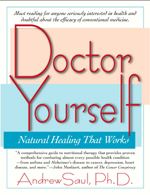
Doctor yourself - take responsibility for your own health - is the motto of Andrew W. Saul, one of the major proponents of orthomolecular medicine, a system of health care based on supplying the nutritional elements we are often missing in our diet.
We are moving into a third healthcare revolution says Kathryn Alexander, one of the leading experts in detoxification and dietary healing who lives in Queensland, Australia and who has lectured on the dietary approach to health in the USA, Europe and Australia.
Kathryn has traced the forces for change in our medical system. She says that the internet-driven knowledge revolution and the new tendency to electronically record patient data in electronic health records may be helping to overcome the current, profit-centered approach to health. By analyzing the collected data we will discover what actually works and start to rearrange healthcare to be more efficient.
The fact that our personal health records are actively being collected and will in the future be coveted objects of trade, according to Kathryn will actually catalyze patients, the real owners of these personal data, to band together. Patients will become a force in their own right with policy forming and decision making powers and together, they might just be able to tip the balance in favor of real prevention...
These articles are brought to you strictly for educational and informational purposes. Be sure to consult your health practitioner of choice before utilizing any of the information to cure or mitigate disease. Any copyrighted material cited is used strictly in a non commercial way and in accordance with the "fair use" doctrine.