|
|
June 26, 2007
Is Food Production Feeding the 'Population Bomb'?
There is a view, expressed in papers by Russell Hopfenberg, that human population continues to increase as a function of the availability of food. The corollary and suggested remedy is that, putting a cap on food production, we can stop human population from further growing. The implied problem of population increase is that we are eating up our environment - we are diminishing the vital space of thousands of different species leading to their extinction, all in the name of food production.
Personally, I believe that this is an oversimplified view and that, although we do cause havoc in the environment, population numbers may not be the exclusive or even the principal culprit in this play.
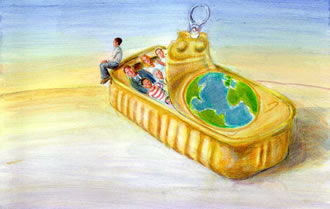
Overpopulation?
Some time ago, Steven Salmony contacted me by making comments on this site, arguing the view that we must recognize population growth is the major problem facing humanity, and that we must do something about it. Although he did not directly say that humanity needs to be starved into shape, the suggestion was that capping the food supply could slim down the population into acceptable numbers. At the time, I posted Overpopulation - Does Population Growth Follow Food Supply?, organizing the exhortations and successive comments, and my somewhat doubting replies into an article that could give an idea of both sides of the argument.
The reason I come back to the theme of overpopulation and food supply now is an invitation by a friendly lady to take part in a discussion on the guestbook page of a website about the writings of Daniel Quinn, who seems to be a great fan if not the originator of the idea that human population increases whenever food is produced in abundance. Read on, to see what the discussion was about and how I responded...
Here is the message I received:
On 24/giu/07, at 18:54, Ms Z. S. wrote:
Hi Sepp. We don't know each other very well, but i admire our mutual friend Steven Salmony. Because i appreciate your perspective on ecosystems and the human place in them, i'd like to ask you a favor. Or at least invite you into conversation.
The Ishmael Guestbook is a place where i go to discuss such matters. A guest there, a student from Toronto named Ryan, has posed more of a challenge than i have yet met. Specifically, he's convinced of a human exceptionalism that imagines it's ok to turn wilderness into human food without causing population growth, in denial of the basic ecological principle tying population of every species to their food supply. i'd like to ask you to share your opinion there. If you are aware of any sources of scientific thought showing that the basic dynamics of population as they are known to ecologists also apply to the species homo sapiens, access to those sources would be appreciated.
Your own post, however brief, would better convince, but if you are uncomfortable with that, any references or quotations you can supply could be introduced in one of my posts. A single sentence or link could be of help, thanks.
The Guestbook is at http://www.ishmael.org/Interaction/Guestbook/guestbook.cfm and near the top is a place to click to add an entry.
You are welcome to read the most recent few posts if that helps you find your place in the discussion.
Thanks for anything you may contribute.
- - -
I did read some of the recent contributions as suggested. If you want to look into that discussion, go to the Ishmael guestbook page and start reading at entry number 14686...
Here is my reply, penned or rather keyed after getting an idea of the problem brought to attention by Ryan:
Hello Z.,
thank you for your mail and the invitation to join the discussion on the guestbook page of ishmael.com.
Well, after reading the last thirty, more or less, posts on that page I am not so sure that what I have to say would be welcome there.
My thoughts are close to what Ryan expressed in his posts.
The first thing I would ask is: If it is true that availability of food causes populations to increase, then how is it that the countries where food is most abundantly available to every citizen (the industrialized group of nations) have the lowest birth rates of all countries on the planet, and conversely, why is it that the poorest countries seem to have the highest birth rates?
Do these facts not immediately invalidate the contention that food supply is causally related to births, except, perhaps, in the inverse way - the more food (and food security) the less births, the less food (and food securtity) the more births in each family.
I believe I have brought this up with Steven before, but have not had a satisfactory answer.
To check out my argument, look at this page of countries by fertility rate. You will roughly see the poorest countries with the highest fertility rate, and the richer ones having correspondingly much lower fertility rates.
Both Italy, the country where I live, and Germany, where I was born, have extremely low fertility rates, and I can assure you that no one goes hungry in either country.
Now I do agree that our exploitation of the planet's resources is not sustainable, and I submit it may be the way we obtain our food that is not in keeping with the times.
In ancient times, people could just roam, hunt and gather what fruits and roots they found and live off them.
then came agriculture. That allowed more people to be fed with less land.
we now need to transit to the next step, that is, we need to overcome the agriculture age and start growing our food from an abundantly available resource with a technology that is sustainable. I am thinking of sea water as an abundantly available resource, and microalgae that grow in sea water as a nutritious, complete, and in principle abundantly available source of food. We can always complement with things we hunt and things we farm, but the bulk of our food will have to come from a new, sustainable source.
Next, I believe that it is not food security so much as economic security that makes people look up and say "we want less children". Where economic security is absent, and people live off the land, it is practically indispensable to have numerous offspring, because they are the labor that will sustain an aging couple into their old age until their death. Absent numerous children, a subsistence farmer could starve in old age, and therefore there is every incentive to have more than just one or two children. The children assure future economic survival.
One of the questions that has been asked in the discussion is how COULD the populations of several of the poorer nations be better off in a realistic way. This is a very tricky one that cannot be answered without looking at the basic economic set-up of our society. We have an economic and monetary system that practically obliges any country to expand economic activity unless it wants to see its people starve. The reason our system requires constant economic expansion, and thereby ever-increasing exploitation of natural resources is hidden in the very basic economic set-up.
Our money is issued by private interests, which consider it as their property. These interests ask us to pay a fee (called interest) for the use of their money. Economic activity cannot sustain that fee unless there is a constant expansion of the activity. In order to change this, we will need to change the basics of our economic/monetary system. We need a means of exchange (money) that is not the property of any private interest and that is not weighed-down by the necessity to pay interest for its use. In that way, those countries that are poor today could start working for their own economic prosperity rather than for paying interest on foreign loans or on the very money they are using.
That, in my view, would increase economic security and would obviate the problem of over-population. It would also obviate the problem of over-exploitation of our limited planetary resources, letting things cool down so we could live comfortably while not having to constantly procreate to assure survival. Population numbers would stabilize without having to force either a one-child-policy such as China does, or a diminished food supply, as the prevailing mood of the discussion seems to favour.
You are welcome to post this view of mine to the discussion, although I clearly don't expect you to do so, seeing that the overwhelming majority of participants seems to be looking for ways to explain and justify and back up the view they have taken on, of over population being driven by availability of food.
Kind regards
Sepp
p.s. I very much enjoyed reading the second linked article in your message on a new renaissance, and can only wholeheartedly agree, that we need a profound change if we are to survive into the future. That change, in my view, is going to be people realizing that they are not just biological mechanisms but the crown of creation. People will realize that their real beingness is a high spirituality, rather than mammalian instincts and they will start acting in accordance with that realization. Part of that change in our way to see things will be to see other species as every bit as important as our own, and we will do whatever we can to no longer destroy the habitat of these other species just to satisfy one of our mammalian needs - that for food.
See also:
Reaching for the Future with All Three Hands
Address by Daniel Quinn, Kent State University, Earth Day, 1998
Natural World Consciousness
Lee C of achinook.com writes:
If one understands the ecological principles of food web trophic levels, then one should understand that a consequence of our ever increasing population, relative to the essential biodiversity of higher life form conducive natural ecosystems, is that we're causing the extinction of an alarming number of other life forms daily just to support our own biomass. We're systematically shifting the biomass of the many life forms we're not smart enough to care about, into the biomass of a lesser number of life forms we use to maintain our own biomass (e.g. cows, chickens, corn, beans, tomatoes, ...). That is, we're systematically diminishing the biodiversity of the natural biological communities, and in so doing are destabilizing nature's infrastructure that is keeping us alive.
The key factors of healthy ecosystems (in the sense of being conducive to human existence) are sustainable long term productivity through extensive biodiversity to exploit all the ecological niches (in time, space, and kind), and relative stability through the overall balance of ecological processes in minimizing ecosystem state shifts. This more complete utilization of limiting resources at higher diversity increases resource retention through more thorough and efficient recycling increasing productivity, and the balance of inherently more intricate ecological processes promote stabilization.
For a better understanding of how we are jeopardizing the shorter term state of human existence on Earth, see the article Natural World Consciousness at achinook.com
Will objective understanding or subjective beliefs prevail?
posted by Sepp Hasslberger on Tuesday June 26 2007
updated on Friday April 29 2011
URL of this article:
http://www.newmediaexplorer.org/sepp/2007/06/26/is_food_production_feeding_the_population_bomb.htm
Related Articles
Overpopulation - Does Population Growth Follow Food Supply?
On a recent post of mine regarding the Aerospace Technology Working Group (ATWG), a series of comments brought to light an interesting train of thought on human overpopulation. Steven Earl Salmony pointed out that according to an article of Russell P. Hopfenberg, human population dynamics are common to the population dynamics of other species. This means the world's human population growth is a rapidly cycling positive feedback loop, a relationship... [read more]
March 20, 2005 - Sepp Hasslberger
Third World Economy: Is Foreign Aid Destructive?
"Foreign aid might be defined as a transfer of money from poor people in rich countries to rich people in poor countries." -- Douglas Casey - classmate of Bill Clinton at Georgetown University But foreign Aid comes with a feel-good factor. We can be satisfied that we are - our countries are - contributing to the economic well-being of starving people in the Third World. Even if only a small... [read more]
June 04, 2005 - Sepp Hasslberger
New Hampshire: Beginnings of a Freedom Revolution?
If there is a place in the US, where the original dream of a free country and freedom for citizens is alive and well, it may be New Hampshire, home of the Free State Project. "The Free State Project is an effort to recruit 20,000 liberty-loving people to move to New Hampshire. We are looking for neighborly, productive, tolerant folks from all walks of life, of all ages, creeds, and... [read more]
March 02, 2007 - Sepp Hasslberger
Microcredit - You Can Help Break the Cycle of Poverty
Without donating a penny, you can help to break the cycle of poverty in a very real way. Simply by placing a $1,000 microcredit investment you can pull several families in the developing world out of poverty for every year your money is invested. This is not a donation or charity. Like other investments, you eventually get all of your money back. You even earn a small amount of interest... [read more]
October 23, 2005 - Sepp Hasslberger
Third World Economy: Is Foreign Aid Destructive?
"Foreign aid might be defined as a transfer of money from poor people in rich countries to rich people in poor countries." -- Douglas Casey - classmate of Bill Clinton at Georgetown University But foreign Aid comes with a feel-good factor. We can be satisfied that we are - our countries are - contributing to the economic well-being of starving people in the Third World. Even if only a small... [read more]
June 04, 2005 - Sepp Hasslberger
Readers' Comments
A comment from an unnamed friend in the US (by email):
Your reply to the depopulation people was heartening. I see solutions to all our pressing problems in permaculture of the Bill Mollison and Geoff Lawton school of permaculture. The globalists\' formula for abundance is and has always been \"abundance\" (for a few) based on debt and destruction. As long as that model is in place there will be scarcity. It\'s like trying to get out of debt by getting a different credit card. And as long as masses of people participate in that economy, it will remain in place. The economy of permaculture geniuses Bill Mollison and Geoff Lawton is based on actual wealth--not exploiting anyone or sacrificing a part of the environment to solve an environmental problem. It looks like win/win/win.
- See: The Permaculture Concept (6 parts): (I watched it on YouTube, but like the idea of open source; not sure if all 6 parts are at this link).
- See Permaculture Research Institute: (watch Greening the Desert and get blown away and \"Compost Miracles\" and \"The Functioning of Weeds in Wholesome Gardening\" at http://permaculture.org.au/index.php?s=articles&submit=Submit).
- See articles on health and healthy soil, many features on permaculture specifics, and interviews with Geoff Lawton at http://permaculturetokyo.blogspot.com
Posted by: Sepp on June 28, 2007 05:47 AM
A comment received from D. in Canada (by email):
Just read your article re the correlation between food supply and overpopulation and noted the absence of something I feel is critical to the argument, that being that while the birth rate is referred to everywhere, the death rate is not.
The facts of the matter include that there is a definite depopulation agenda afoot, and has been for a very long time. It is not even close to true that there is not enough food on this planet to feed everyone. There is plenty of food, but the production/growth and distribution of that food is highly unequal. In fact, the entire food supply of the world is being messed with, in ways that include genetic modification, pesticides, fertilizers, hormones, and all manner of synthetization, as well as political interference.
The bottom line here, I think, is included in a statement made many, many years ago by Robert MacNamara, who was the head of the World Bank at the time, and who also was Secretary of State for the USA: MacNamara said that \"we must take aggressive measures of depopulation. How? By natural means -- famine and disease.\" Coupled with that statement has been a lack of assistance to countries to make them self-sufficient, shackling whole nations with unpayable debt to the IMF and World Bank, debt vultures who buy up the debts of nations and blackmail them for aid money to repay the purchased debts, massive vaccination programs, food programs that supply GM foods, farm programs that supply terminator seeds, you name it. Now even Bill Gates has got into the act. And since he invested heavily in Pharma companies when he was on the AIDS drugs kick, one must wonder what sort of stock he is currently holding in Monsanto and the other companies who are supplying such garbage to starving people.
I agree it is an oversimplification to try to tie the birth rates to the food supply, and provides a twisted view of what is happening. It\'s not that the children are BORN... after all, what entertainment DO the poor have in these countries besides sex? Cable? Casinos? Nightclubs? Perhaps a round of golf? They are poor in more than money: they lack education, they lack information, they lack outlets for their stresses, they lack most of the common comforts we all take for granted. Yes, they produce pregnancies like they\'re going out of style. But these children are starving. Having been born into poverty, many die from famine, as MacNamara suggested was right. But in addition, their elders also become ill and die in horrendous numbers, because their bodies break down from malnutrition. And so the population growth is a factor of both births AND deaths, in which figures nutrition, health care, forced vaccinations, and God knows what other horrors foisted upon these poor people while we in the opulent West believe that \"Aid\" programs actually work, because we\'re told they do.
What is interesting is that now, our opulent society is suffering from similar attacks on their wellness, and thus their ability to reproduce, raise healthy, viable children, and live to a ripe old age.... exactly the same! Vaccines, toxic pharma drugs, bad nutrition, health agencies complicit with corporations instead of protecting health, bad information, the lot. It\'s under a different rubric, of course, but IT IS THE SAME. Those who think that people\'s food supply should be messed with \"in order to \'save\' the world\" need to realize that this is an agenda, with a paradigm of mis- and dis-information behind it all. And most particularly, they need to realize that there is a target painted on their own asses.
We ALL need to eat locally grown food, unadulterated and pure as Nature made it. That includes those in starving nations. Allowing corporate control of the provision of the necessities of life is a huge error, given that these same corporations are now controlling governments worldwide, and given that failure to feed our brothers is a crime against humanity.
Population growth is of course relevant. None of us wants to resemble those poor \"sardines\" in the illustration you posted with your article. But we humans can be creative and intelligent, when we drop the shackles. We could solve these problems. But we will not be able to solve anything until we take our power back as human children of the same God, members of the same family, and take care of our own. I fear that will not happen. People are not willing to look at the complicity of governments in the willful destruction of whole populations by corporatocracy, any more than they are willing to look at the complicity of government with Big Pharma in health care.
It is unfortunate that the tone of the blog has been so oversimplified. Otherwise there might actually be some honorable solutions proffered, instead of pontificating about the sacrifice of the few to save the many.
Cheers,
D
Posted by: D. on June 29, 2007 07:06 AM
While I would prefer not to diss politicians, many of them who are primary beneficiaries of the 'first' world's political economy appear to suffer from what has been named a "nature deficit disorder.�? Indeed, many too many leaders among us in the developed world seem to have lost touch not only with the natural world but also with good science and humanity. Who knows, perhaps the empire-builders and politicians and mass media moguls of the dominant, industrialized culture of conglomerates have become utterly mesmerized and generally misdirected in their relentless, unbridled pursuit of the golden calf.
After all, we know that several hundred leaders, often serving on multiple executive committees and boards of directors in quasi-secret organizations like The Trilateral Commission, Bilderberg Group and Council on Foreign Relations, exert extraordinary influence upon politicians and minions in the mass media through their billion dollar bank accounts. They manage the world's interlocking national economies and direct the course of economic globalization. At least to me, these leaders appear to be leading a charge that could inadvertently squash and utterly subordinate the sacred of this world to the profane............ with potentially intolerable consequences for the future of life on Earth.
At its current scale and anticipated rate of growth, the continuous expansion of the world economy we see today may be approaching a point in human history when unbridled production, unchecked per human consumption and skyrocketing human population numbers could overwhelm the limited natural resources and frangible ecosystem services of Earth, upon which life itself depends for it very existence.
Is it not the circumstances of unrestrained, human-driven "overgrowth�? activities worldwide that need to change? Perhaps leaders are now called upon to lead by regulating the global growth of human numbers, per capita consumption and endlessly expanding production capabitities so that we find a balanced relationship with nature and, consequently, give this marvelous planetary home God has blessed us to inhabit the time it requires for self-renewal. In our time, people are dissipating more resources than can be restored by the Earth for human benefit.
Or we could choose to stay the current "business as usual�? course by maximally increasing production and recklessly dissipating limited natural resources, thereby causing economic globalization to continuously grow in a patently unsustainable way. Then distinctly human over-consumption, overproduction and overpopulation activities would commandeer remaining original wildlife habitats, massively extirpate biodiversity, degrade fragile ecosystems and, very shortly, engulf the planet, would they not?
One primary concern of mine �? that needs not to be bound up in silence �? is that politicians, their billionaire club business benefactors and their minions in the mass media have themselves introduced a "code of silence�? regarding what is being discussed in this blog and similarly situated vehicles of communication. They will NOT openly discuss one topic: the maintenance of the integrity of Earth's ecosphere, its biodiversity and its natural resources. They do not speak publicly about good scientific data indicating that the current scale and rate of growth of seemingly endless economic expansion could become a patently unsustainable enterprise in the next decade of this century. Can you find public presentations by these self-proclaimed masters of the universe on the potential threats of biodiversity extinction, environmental collapse and, perhaps, human endangerment that could soon be posed by their willful determination to continue the unbridled, maximal extension of BIG business activities worldwide?
Until now, such discussions as this one could not be maintained and, for the moment, remain marginalized from mainstream, mass media communication. Even so, the times...........they are changing, thanks to people like Sepp Hasslberger and Zot Lynn Surgot. More and more people are speaking out loudly and clearly for good science, humanity and the preservation of the Earth, and being heard despite the deafening silence that still surrounds us.
This is only a guess, but one day soon the word ECOLOGY will be spoken in mainstream, public discourse as freely, forcefully and often as the word ECONOMY. One day I believe many leaders among us will substitute the word ECOLOGY for the word ECONOMY in the following sentence.
DO NOT DO ANYTHING THAT HARMS THE WORLD\'S _______.
Posted by: Steven Earl Salmony, Ph.D., M.P.A. on July 15, 2007 10:43 AM
I. Making the case for a reduction in absolute global human population numbers.
2007 World Population Data:
http://www.prb.org/pdf07/07WPDS_Eng.pdf
II. Making the case for a reduction in per human consumption of limited resources.
The Wealth Report: Living Large While Being Green �?- Rich Buy 'Offsets' For Wasteful Ways; Noble, or Guilt Fee?
24 August 2007
The Wall Street Journal
It's not easy being green �? especially if you're rich.
With their growing fleets of yachts, jets and cars, and their sprawling estates, today's outsized wealthy have also become outsized polluters. There are now 10,000 private jets swarming American skies, all burning more than 15 times as much fuel per passenger as commercial planes. The summer seas are increasingly crowded with megayachts swallowing up to 80 gallons of fuel an hour.
Yet with the green movement in vogue, the rich are looking for ways to compensate for their carbon-dioxide generation, which is linked to global warming, without crimping their style. Some are buying carbon "offsets�? for their private-jet flights, which help fund alternate-energy technologies such as windmills, or carbon dioxide-eating greenery such as trees. Others are installing ocean-monitoring equipment on their yachts. And a few are building green-certified mansions, complete with solar-heated indoor swimming pools.
Some people say the measures are a noble effort on the part of the wealthy to improve the environment. Eric Carlson, executive director and founder of the Carbon Fund, a nonprofit that works with companies and individuals to offset emissions, says the wealthy are taking the lead in alternative-energy markets such as solar technologies just as they take the lead in consumer markets.
"Obviously these people have different lifestyles from yours or mine,�? Mr. Carlson says. "At the same time, they're not obligated to do anything. We praise those who are doing things. We're trying to get to a market where the superwealthy are leaders in reducing their [carbon dioxide] footprint and playing a major role in changing this market.�?
Others say the efforts are little more than window-dressing, designed to ease the guilt of the wealthy or boost their status among an increasingly green elite. Environmentalists say that if the rich really wanted to help the environment, they would stop flying on private jets, live in smaller homes, and buy kayaks instead of yachts.
"Carbon offsets and these other things are feel-good solutions,�? says Lester Brown, founder and president of the Earth Policy Institute. "I'm always interested in people who buy a carbon offset for their jet to fly between their four big homes. These kinds of programs postpone more meaningful action.�?
Either way, an increasing number of companies are launching programs designed to help the rich live large while staying green. Jets.com, a private jet service, plans to start a program in early September in partnership with the Carbon Fund. After they take a trip, customers will get a statement on their bills telling them how much carbon dioxide their flight emitted and what it would cost to buy offsets from the fund.
The offsets are a bargain compared with the flights: A round-trip private-jet flight between Fort Lauderdale, Fla., and Boston costs about $20,000. The offsets for the 13 metric tons of carbon dioxide emitted would cost about $74, the company says.
V1 Jets International, a jet charter company, rolled out its "Green Card�? program that it says accentuates "the positive effect your flight emissions will have on the environment.�? The company calculates the total emissions from the trip and then buys a carbon offset from the Carbon Fund. "From a jet perspective, we have a responsibility to look after the damage that these planes do,�? says Andrew Zarrow, V1's president. The company also has created technologies designed to make flights more efficient by selling seats on "deadleg�? trips �? flights that are returning empty from one-way trips.
Yacht companies also are getting into the act. Trinity Yachts, a Gulfport, Miss., builder, this month announced it will pay for part of the cost of installing special oceanographic and atmospheric monitoring systems in all of its new boats.
The system, called the SeaKeeper 1000, measures water temperatures and salinity, as well as air temperature and wind speed. The data are sent to scientists who monitor the earth's oceans. Trinity's program is in partnership with International Sea-Keepers, a nonprofit marine conservation group founded by a group of yacht owners concerned about the environment.
"The caliber of client we have is very aware of what's going on in the environment,�? says William S. Smith III, vice president of Trinity Yachts. Still, the system doesn't reduce emissions from the yachts themselves, which can burn hundreds of gallons of fuel a day.
Some wealthy people are going green with their houses, too. The U.S. Green Building Council has certified at least three mansions for being leaders in environmental design, including one owned by Ted Turner's daughter, Laura Turner Seydel, and her husband, Rutherford, in Atlanta. The 7,000-square-foot-plus house, called EcoManor, is equipped with 27 photovoltaic panels on the roof, rainwater-collecting tanks for supplying toilet water, and "gray water�? systems that use water from the showers and sinks for the lawn and gardens. The top of the house is insulated with a soy-based foam that is more efficient than fiberglass. The home has 40 energy monitors and a switch near the door that turns off every light in the house before the family leaves.
Mr. Seydel says the couple's energy bill is about half that of comparable homes. While he acknowledges they could have built a slightly smaller house, he said all the space is well used, between kids and visiting friends and in-laws.
"The wealthy have always been the early adapters to technology,�? he says. "I'm hoping that we can pave the way and show that you can have something that's luxurious that also makes a lot of sense from an energy and convenience point of view.�?
III. Making the case for a reduction in the seemingly endless economic globalization activities of BIG BUSINESS now overspreading Earth.
In Praise of Mother Nature
By Bret Schulte
Posted 7/15/07
US News & World Report
Science writers generally don't do whimsy, particularly those who have witnessed the aftermath of Chernobyl or the plundering of Latin America's resources. But in his provocative new book, The World Without Us, Alan Weisman adds a dash of fiction to his science to address a despairing problem: the planet's health. Weisman wonders how Earth would fare if people simply disappeared. With help from experts, Weisman discovered that, untended, humanity's achievements would stand little chance against Mother Nature, even in her weakened state. Sans electric pumps, the New York subway would flood within days. Pretty flowers would quickly crack sidewalks. And the life span of your house? About 50 years. Weisman spoke to U.S. News.
Environmental books are often depressing reads. Does framing a message around a hypothetical make it more approachable?
I would say so. I was looking for some way to seduce readers to keep following along so they could see what is going on in the world and how it all connects. Ultimately, once we take humans out of the picture we see how the rest of nature could flourish. We think, "Wow, if nature could do all that, then is there a way that this could happen that does not depend on our extinction?�?
Your book takes us to a 14th-century European hunting preserve and demilitarized zones where nature has a free hand. Were you surprised by what you saw?
It was pretty weird. This fragment of primeval European forest on the Poland-Belarus border literally feels like it's out of Grimm's fairy tales. That's what it looks like, that's what it sounds like, that's what it smells like. But the incredible thing is that it doesn't feel exotic. For someone growing up in Europe or North America, it feels familiar. It feels right.
How did your visit to Chernobyl lead to this book?
I got a call in 2003 from an editor at Discover magazine who read the 1994 story I wrote after the explosion at Chernobyl, where I described how abandoned houses were being taken over by their own landscaping. Roots and trees and even flowers were breaking up sidewalks. A population of radioactive deer kept growing, and radioactive wolves kept coming after them. In 1994, she thought the article was depressing, but as she was editing all these depressing environmental stories, she said it had become one of the most hopeful stories: that no matter how badly we screw up, nature will find a way to overcome it.
What did you take away from these places?
I wasn't really expecting to realize the history of architecture is kind of like a bell-shaped curve. Our first dwellings were caves, then we started making caves-houses out of rock-and as we got more refined, our buildings grew higher and less permanent. Engineers tell me that our oldest buildings will outlast the newer ones…because we don't make
them the way we used to, out of material from the Earth. The World Trade Center collapsed and St. Paul's Chapel, which is made out of Manhattan schist, is still standing. Other buildings around the World Trade Center that did not get hit by the airplanes collapsed anyhow.
Is this book a cold splash of water for humanity's many triumphs?
In some ways it's a wake-up call, but at the same time humans have done some beautiful things, things you have to admire. One of the surprises for me is coming away with so much respect for the people who maintain our infrastructure. If it wasn't for these guys keeping the bridges from rusting, or who keep our subway tunnels pumped, or who show up every day at our nuclear plants, stuff would start to disassemble rapidly. We live on the backs of some unsung heroes who are keeping it all together.
Three things: One of them is lovely, the Voyager spacecraft carrying our artwork, our music. I talked to John Lomberg, who put all that together for Carl Sagan, and it was beautiful to talk to someone who thought about what the message to posterity should be. On the darker side: nuclear waste. Depleted uranium has a 4.6 billion-year half-life. The planet is only going to last about 5 billion years before the sun expands. The other thing is plastics. No one really knows how long it will take for plastics to break down because they're relatively new. Plastic isn't filling up landfills; it's blowing into rivers and flowing to the ocean. It's breathtaking how much plastic we've generated.
Your book ends on a controversial note.
I ask: What if we tried one child per family for everyone? I don't want to deprive people of siblings, but I don't want to deprive people of species that are wonderful and part of our life. We can't live without them. If we could bring our numbers down, that would buy us some time to clean up our act.
Posted by: Steven Earl Salmony on August 25, 2007 04:28 PM

This work is licensed under a Creative Commons License.
These articles are brought to you strictly for educational and informational purposes. Be sure to consult your health practitioner of choice before utilizing any of the information to cure or mitigate disease. Any copyrighted material cited is used strictly in a non commercial way and in accordance with the "fair use" doctrine.
2908
|
|