




New Zealand - Resisting Aussie Health Takeover
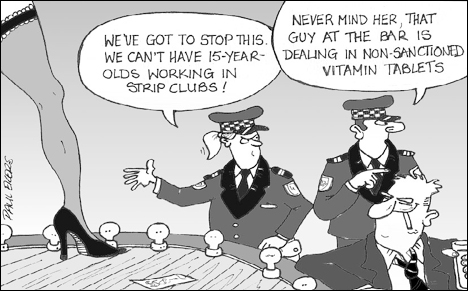
Health conscious New Zealanders are facing a threat to their freedom to choose natural ways and means for taking care of their health. According to an agreement between the governments of New Zealand and Australia, signed in December 2003, Natural Health Products are to be regulated by a joint agency modelled after the Australian Therapeutic Goods Administration. That agency has shown an extremely heavy-handed approach to supplements when last year in April, it pulled well over a thousand natural products off the market, on the strength of one manufacturer's lax handling of quality control standards.
New Zealand's newly organized resistance is centered around a web site that will act as a product information center and point of self-regulation, as well as a rallying point for the expected political battles around this issue. The site is not fully operational yet, but a newsletter is already being offered. Find out how to keep current on this issue. Thanks to David Holden and Kiwi Joe (Liston Bateson) for the information.Update 25 April: (received from Kiwi Joe)
On Sunday 18th April 2004 Ken McIvor presented to the Governing Council of the New Zealand Charter of Health Practitioners (NZCHP), the final version of the Joint Agency Treaty.
The alarming thing is that this final version of The Treaty was written 6 months ago. It was mailed out 2 days before Easter and the Charter Office received it on 14th April.
The representatives at the meeting voted Ken and Paddy to prepare a submission on behalf of the NZCHP. This needs to be completed by 26th April along with 25 copies which Paddy and Ken will then present to Wellington 28th April.
The time factor is interesting- creating a rush at the last minute. Government has done this before, sending such papers during public holidays. The Treaty does not include Sections 32 and 28 of the Medicines Act 1981. These sections involve the Basic Common Law Right for the dispensing of herbal remedies and other products.
It will affect hundreds of herbs and other products currently being dispensed and it will put some natural therapists out of business because of the application of, for example, oils.
Please pass this update to other practitioners and clients as it is important to realise the stage we are at with The Joint Agency Treaty, also to know what the NZCHP is doing on our behalf. We will keep you informed in the future.Update 31 March 2004:
Officials agree Trans-Tasman Treaty will cost jobs and increase pricesConsumers and the economy will pay a heavy price for the Government's insistence on a Trans Tasman regulatory system for natural Health Products, according to a report by Ministry of Health officials released yesterday.
The National Interest Analysis was tabled as Government put a Trans-Tasman treaty signed late last year before Parliament for ratification.
Opponents of the proposed Trans Tasman scheme have been claiming it would see products pulled from shelves, costs of products go up and jobs disappear as many of the industry's small players close down or relocate to Australia.
"After months of the industry saying it will be a disaster, finally officials have admitted that this proposal will see consumers and the New Zealand economy suffer," said Amy Adams, spokesperson for the NZ Health Trust.
"Health Minister Annette King appears determined to proceed with this destructive and counterproductive system, despite intense opposition from industry, the public and the Health Select Committee."
The NZ Health Trust is also angry that the National Interest Analysis claims that industry submissions were based on misinformation, saying that the real misinformation in this case is coming from MedSafe officials.
"For example it claimed complimentary medicines need to be regulated in this way because the Pan Pharmaceuticals situation proved that generally safe natural products can be dangerous if manufactured incorrectly" Mrs Adams said. "The truth is that of more than 1200 products recalled, NOT ONE of the natural health products was found to be at fault. It was only one pharmaceutical drug which was a problem."
She said Government could expect more determined opposition. "Industry and consumers will not put up with natural health products being sacrificed on the altar of Closer Economic Relations by a desperate Government."
For further information you can contact
Amy Adams Ph (021) 499-066
NZ Health Trust Spokesperson
24 February 2004To all those involved with Dietary Supplements or Natural Health
Contact: Amy Adams / Dave Sloan
E-mail: nzhealthtrust@ihug.co.nz
You may be aware that the Government is trying to change the way in which all Natural Health Products (NHPs) are regulated. They plan to treat NHPs as medicines and give the power to control them to the controversial Australian Therapeutic Goods Administration (TGA).What is known from the Australian experience is that to treat NHPs as drugs and to make them subject to the heavy handed bureaucracy that goes with it will mean that many New Zealand businesses will be forced to close taking current products off our shelves. The products that do survive are likely to be much more expensive as suppliers are forced to recover regulation costs. What’s more, because regulation will come from Australia, there will be very little New Zealand can do to protect itself.
Despite strong opposition from industry and a Parliamentary Select Committee report against the proposal, Annette King signed the Treaty with Australia on 10 December last year. BUT the battle is far from over. The Government still needs to have the treaty passed into law and for that it needs support from other parties. ALL opposition parties in Parliament (National, ACT, Greens, United Future and NZ First) have now unanimously condemned the Governments actions.
This proposal will seriously limit our freedom of choice in New Zealand and our access to NHPs. To make sure it does not happen the industry needs to show organisation and a willingness to work within a sensible NZ system of regulation.
To do this the NZ Health Trust, which has been one of the leading objectors to the Government’s proposal, has developed a web site called myHealth to act as a national directory of NHP’s.
This site allows consumers to find out what products are available and how & where to get those products. It is a little like a web based ‘Yellow pages’ for NHP’s. Plus, by establishing the site we can show the Government the advantages of centralised web based, self registration systems rather than the heavy handed Australian approach. The site is in the final development stages for product listing and searches. The newsletter database function is complete.
We can stop the Government’s TGA proposal but only if we are strong & united.
Please log on to www.myHealth.co.nz and enter your name and email address in the newsletter section to subscribe to the myHealth newsletter and we’ll make sure you are kept informed. You can unsubscribe at any time and your details will only be used to send you items of specific information.
NEW ZEALAND HEALTH TRUST
Related articles:
Eve Hillary describes - with reference to a real case - how the shocktroops of medical orthodoxy operate in Australia. An interesting read, although the file (download in PDF format) is 23 pages long.New Zealand Counter-Assaults Big Pharma...
by Consumer Advocate Tim Bolen
The battle for reality in health care rages across Planet Earth. Big Pharma, in its murderous greed, throws money at its minions like hale on a Kansas farm. Despite massive cash infusions to protect their deadly interests - they are NOT winning. Attached is a story sent to me from New Zealand, detailing the efforts of the New Zealand Health Freedom Movement - where they are, so to speak, battering Big Pharma's goon squads in the streets...No evidence of danger in dietary supplements
Political pressure in New Zealand against Trans-Tasman therapeutic products agency:
Govt compromises on therapeutic agency
Monday, 12 December 2005
Delaying the date for establishing the controversial trans-Tasman therapeutics agency will not help the Government get the numbers if it does not change its position on dietary supplements, according to the Green Party.
February 2004: Here are some first details on how the planned joint agency is to regulate supplements in both countries. Apparently, there will be a list of "allowed" substances similar to what the European food supplements directive has established, and what already exists under the present Australian system which classifies supplements as "therapeutic goods" under medicines law:Medsafe has issued a request for sponsors to list products that have been supplied into the New Zealand market during the 2003 year. This is in order to compile a list of permitted ingredients for the Joint Agency. The Agency needs to have a permitted ingredients list for the joint agency prior to commencement of the joint scheme. Australia already has such a list under its current regulatory system, and the substances on that list will be transferred to the new joint agency's permitted ingredients list. Ingredients in complementary medicines marketed in New Zealand may also be able to be included in the list following an evaluation of safety and quality. Products containing an ingredient that is not on the permitted ingredients list will be permitted to be sold in New Zealand for the duration of a transition period provided that sponsors comply with the transition arrangements. During this time the sponsor will need to submit to the agency product licence applications for evaluation of each product the sponsor wishes to continue marketing.
It is to the sponsor's advantage to ensure that all ingredients are identified early so that evaluations can be completed and ingredients considered suitable included in the agency's permitted ingredients list. Sponsors are requested to compile a list of all ingredients included in products you are currently manufacturing or distributing in New Zealand, and declare that these ingredients are present in products that have been manufactured, imported or sold in New Zealand during 2003. Industry associations have agreed to collate lists from their members and forward a consolidated list to Medsafe.
In order for a 'master' list of ingredients to be compiled and for evaluation work to begin as soon as possible, Medsafe requires information by 31 April 2004.
March 2004: Information from MyHealth. You can subscribe to a newsletter directly on their site.
Many of you will be aware of the Government plans to set up a Trans Tasman regulator which will control this industry and which will be an effective extension of the Australian Therapeutic Goods Administration system. This proposal has been strongly criticised by those in the industry and was unanimously rejected by the Health Select Committee in its report in December last year.The Government though is still trying to force the changes through that experts predict will result in the loss of many products currently available in New Zealand.
A report commissioned by the NZ Health Trust to analyse the Treaty signed with the Australians shows, among many other things:
1. The definition of therapeutic products is so wide that it would include anything taken for health reasons and for that reason arguably would cover fish, vegetables, water and potentially even oxygen.
2. Five stages of regulation are proposed; on importers of ingredients, manufacturers, suppliers, retailers and on exporters.
3. Whilst the Treaty claims to allow some differences in regulation between NZ and Australia, the criteria needed to permit those differences are so limiting that in reality differences would be highly unlikely to ever occur (except for traditional Maori remedies).
4. The Managing Director would have the full power to make rules controlling the industry and yet is not a public servant and does not have report to the Board.
5. Furthermore the powers of the Managing Director could be delegated and sub-delegated and could be carried out by someone of whom NZ has not approved.
6. The treaty enables the new body to further join up with some other international body leading to NZ having even less control than it would initially.
7. All advertisements of any sort, including printed matter supplied with products are to be subject to pre-vetting
8. Most of the detail as to the extent of the regulation has still not been made available meaning that the details of the costs to businesses are still unknown. Asking Parliament to authorise this new body without knowing these details is like asking someone to sign a contract they have not read.
If you want to read the Treaty and accompanying Fact Sheets for yourself these are available at www.jtaproject.com. The Government's response to the Select Committee report is also now available from the Ministry of Health.
January 2006: Trans-Tasman: who knows when?
Speculation is rife as to when the new Trans-Tasman regulatory agency will actually come into being following the announcement late last year of a further indefinite delay to its opening date. The start-up date for the joint agency is now expected to be at least six to 12 months later than planned. The harmonisation project - originally due for completion on 1 July last year - was first extended for 12 months following the 2004 Australian election. The joint Australian and New Zealand ministerial council overseeing the project announced the additional extension on December 11 2005...
New Zealand: No need to buy in to Aussie rules
After five years of fitful debate the Government has given up its attempt to control a wide range of health products - everything from surgical equipment to sunscreens and vitamin pills - through a joint licensing agency with Australia. The proposal, which appears to have come from the New Zealand side, was part of a general effort to extend and deepen our immensely valuable closer economic relations (CER). A few days ago Helen Clark called John Howard to say she had failed...
posted by Sepp Hasslberger on Tuesday February 24 2004
updated on Thursday December 9 2010URL of this article:
http://www.newmediaexplorer.org/sepp/2004/02/24/new_zealand_resisting_aussie_health_takeover.htm
Related ArticlesAustralia/New Zealand Health Agency - NZ Parliament Committee Disagrees
Health conscious New Zealanders are facing a threat to their freedom to choose natural products for taking care of their health. According to an agreement between the governments of New Zealand and Australia, signed in December 2003, Natural Health Products are to be regulated by a joint agency modelled after the Australian Therapeutic Goods Administration. That agency has shown an extremely heavy-handed approach to supplements when last year in April,... [read more]
August 05, 2004 - Sepp HasslbergerNew Zealand: Supplements to be 'Medicines'
For Europeans and Americans, New Zealand and Australia seem so far away we don't usually think that what happens "down under" is going to affect us in any way. Better think twice. What is happening there does have relevance to us. In fact we are facing attempts by the European Union and by the FDA to "regulate" supplements that are not dissimilar to what is happening on the other side... [read more]
May 10, 2004 - Sepp HasslbergerNew Zealand Health Minister Promotes Water Fluoridation
When it comes to fluoridation of the water supply, tempers run hot - both on the pro and the con side of the debate. Fluoridation vastly improves children's oral health say the proponents. Fluoridation introduces toxic components into our food and environment. It has negative consequences for people's health, say some published studies quoted by opponents of fluoridation. One would think that a health minister should encourage debate to find... [read more]
January 11, 2004 - Sepp HasslbergerAustralian Supplement Laws for New Zealand?
It is called Trans-Tasman harmonization, and it's an effort to make the laws the same on both sides of the Tasman Sea, the body of water separating Australia from New Zealand. In this case, we are talking about the laws regulating the production and sale of food supplements, products containing nutrients in concentrated form and in health-effective quantities. Supplements are regulated as medicines - therapeutic goods - in Australia, while... [read more]
December 05, 2003 - Sepp HasslbergerNatural Products Recall in Australia - Push for tougher regulations?
The Australian TGA - Therapeutic Goods Agency - has recently ordered an unprecedented recall of more than a thousand three hundred natural products formulated and produced for other companies by Pan Pharmaceuticals. Public warnings by the agency stated consumers should not use any natural products, while emphasising that there was "nothing wrong" with the pharmaceutical medicines produced by the same company?! Australia and New Zealand have been talking for some... [read more]
June 20, 2003 - Sepp HasslbergerAustralia - Senator Questions Natural Products Recall
The Australian Health Authorities, in June last year, recalled more than a thousand different food supplements manufactured by Pan Pharmaceuticals and had them destroyed in a thinly veiled attempt to destroy the credibility of nutritional products for health care. The mega-sequester came at a time when Australia apparently wanted to show "leadership" in how to deal with natural products, firmly establishing the Therapeutic Goods Administration as the lead agency in... [read more]
February 12, 2004 - Sepp Hasslberger


