




Synthetic honey and GMO bees?
France - 2 July 2003
In a harrowing article, Michel Dogna, health journalist from France, sounds the alarm about what may be one of the biggest ecological catastrophes developing right under our own eyes - and no one seems to be watching.
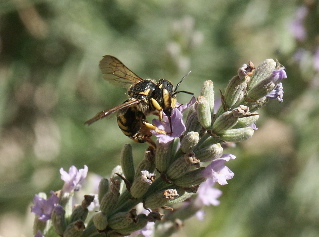
Image credit: Sepp 5 July 2003
As the bees are being decimated by a toxic seed coating agent, our entire food supply is threatened. Plants need bees for pollination, especially the plants we grow for food. Obviously, our busy friends are not part of the equation of the global chemical and food cartels.
What a pity - good bye bees - good bye humanity!
The Bees Die...The Planet Dies
By Michel Dogna
France's Health Freedom Journalist
Translation and transmission :
www.sens-de-la-vie.com/
meaning-of-life@sens-de-la-vie.comThe bees die... and the planet too!
The planet is the common good of humanity. Taking care of it gives life a meaning.
It is necessary to make the farmers understand what their responsibility is, but they seldom have Internet. The bees are the second factor of life on our planet. There is nothing left but our awareness which can act on the totalitarian power of money. It is necessary to react, to transmit this important message to all and to find solutions because it is as serious as the war of Iraq. This poisining is a planetary genocide.
The scandals that are appearing everywhere are nothing compared to the untold catastrophes which are being prepared because of the criminal unawareness of some world lobbies specialized in the massive poisoning of nature. The extermination of the bees by products officially declared as being non toxic is another example of this lack of responsibility.
I am speaking about the extermination of the bees - on which depends 80 % of the pollination of cultivated plants - by Imidaclopride which Bayer sells under the name of Gaucho to the farmers to coat seeds and to protect them from certain diseases...
This product paralyses insects such as bees which cannot return to the hive and they therefore die. When they do succeed, the honey which results from it is toxic (because it's poisoned). In less than three years, 450 000 hives were thus lost and production of honey fell from 45 000 tons to 25 000 tons in France. In Alsace, bee-keepers are regarded as disaster victims because of the Bayer products. In addition, it should be known that in Europe, approximately 4 000 vegetable species have their life assured thanks to pollination by bees.
Meanwhile, Bayer remains indifferent to complaints, and does not hesitate, in it's arrogance, to deny the facts and to claim biodeterioration (biodegradability) of its product within one year, but this one contaminates several successive harvests.
Recently, the Aventis group decided to take a share of the devil's profits with Bayer putting on the market a similar product, Fipronil sold under the trade name Regent. Obviously, in spite of the imminent ecological catastrophe which these products are undoubtedly producing, no government refused to give them the necessary legal authorizations.
Is there a responsible organization somewhere able to demand, in the name of reason and for our children and of the planet, an injunction for the immediate prohibition of the use of these poisons?
Warning: Gaucho and Regent are also sold in the supermarket for gardens. Look at the composition of the products and do not contribute to this catastrophy.
Let us remember the words of Albert Einstein: "No bees, no food for mankind. The bee is the basis of life on this earth ".
The farmers must become aware that with Gaucho, they cut off the branch on which they are sitting. Other solutions exist. In the meantime, the thousands of decimated hives do not give their owners a right to receive any compensation. Due to this, only in the Low-Rhine area, more than 100 new bee-keepers cease their activity each year.
What next? Synthetic honey and GMO bees?
Michel Dogna
Translation and transmission :
www.sens-de-la-vie.com/
meaning-of-life@sens-de-la-vie.com
See also:
Article on bees and pesticide sprays
and more recent (Feb. 2004):
France bans use of six Fipronil insecticides PARIS, Feb 23 (Reuters) - France said on Monday it would ban the use of six insecticides containing Fipronil, an active ingredient notably used in the Regent TS insecticide produced by BASF Agro , because it is suspected of killing bees. Fipronil was marketed under the trade name Regent for use against major pests on a wide range of field and horticultural crops but it is also marketed under other names for insecticides against fleas, ticks or mites (Reuters AlertNet, UK).
Bayer shares fall on insecticide, Roche bid worries
Pesticide accused of killing 90bn bees
February 2007: Mystery killer silencing honeybees
Something is killing the nation's honeybees. Dave Hackenberg of central Pennsylvania had 3,000 hives and figures he has lost all but about 800 of them. In labs at Pennsylvania State University, the Pennsylvania Department of Agriculture, and elsewhere in the nation, researchers have been stunned by the number of calls about the mysterious losses.Mystery ailment strikes honeybees
A mysterious illness is killing tens of thousands of honeybee colonies across the country, threatening honey production, the livelihood of beekeepers and possibly crops that need bees for pollination. Researchers are scrambling to find the cause of the ailment, called Colony Collapse Disorder. Reports of unusual colony deaths have come from at least 22 states.
Update May 2004:26 May 2004 - France suspends use of Gaucho insecticide for corn
French Agriculture Minister Herve Gaymard on Tuesday announced it planned to stop use of the Gaucho pesticide to treat corn seeds until it is reviewed by the European Commission in 2006.
In January last year, Gaymard had already extended for three years suspension of the use of Gaucho, a chemical produced by the German chemicals and pharmaceuticals giant Bayer, for treatment of sunflower seeds.
Gaucho, like another pesticide Regent TS produced by German chemicals giant BASF, has been accused by French bee-keepers of causing a high mortality rate among bees. Sales of Regent TS was suspended in France last February.
An agriculture ministry report deemed that the government's decision to give farmers till June to use up their remaining stocks of pesticide was much less costly that destroying the crop seeds already sprayed. But the national association of bee-keepers says massive damage is being done to bee populations, which are crucial to plant pollination.
Subisidiaries of Bayer and BASF, which sold Regent TS, are under criminal investigation in France for selling an agricultural product that is toxic to humans or animals. (sourche: AFP)
French beekeepers say about 90 billion of their insects have been killed over the last 10 years by a pesticide.The chemical, used on crops including maize and sunflowers, damages the bees' sense of direction so they become lost. It is used in the UK on several crops, though not in exactly the way it is used in France, and British beekeepers have been urged to be on their guard. UK apiarists say the value of bees to the agricultural economy is immense, and they fear bees are becoming rarer.
The chemical implicated in the loss of French bees is imidacloprid, marketed under a variety of names including Gaucho. It is slowly released in the plants, protecting them against insect attack by destroying their ability to find their way.
A London newspaper, the Observer, reported: "Almost immediately after the chemicals were introduced 10 years ago, beekeepers reported that their bees were becoming disoriented and dying.
Used in UK"Within a few years honey production in south-west France fell by 60%. According to the chairman of the national beekeepers' association, Jean-Marie Sirvins, a third of the country's 1.5 million registered hives disappeared. "As a result, France has had to import up to 24,000 tons of honey annually." The pesticide companies say their products are not responsible for killing the bees.
There are no reports of any ill effects from applications of imidacloprid in the UK, where it is licensed for use on beet. There are restrictions on its use when the plants are in flower, or for spraying the foliage. But Richard Jones, the director of the International Bee Research Association, told BBC News Online: "Beekeepers here have to be on the alert.
More needed"The verroa mite, which feeds on the bees' blood, arrived from mainland Europe, and we know that bees' nests can travel a long way on container ships.
"People hear about bees and think only about honey, but it's the other side of the problem that's worrying. "They add billions of pounds to the value of the agricultural economy every year because of their work in pollinating crops like apples.
"We don't have enough bees in the UK, and we have very few feral bees. Every time a hedgerow is destroyed, that means the loss of nesting places for bumblebees."
By Alex Kirby, 1 March 2004
BBC News Online environment correspondent
From: Coalition against BAYER-dangers
CBGnetwork@aol.com
Fax: (+49) 211-333 940 Tel: (+49) 211-333 911
- - -
Where Have all the Honey Bees Gone?by Robert Cohen
(The amazing story of dairy industry culpability)
"If the bee disappeared off the surface of the globe, then man would only have four years left to live." - Albert EinsteinThis from the Penn State Agriculture Magazine, Spring 1998:
"In the spring of 1993, entomologist Maryann Frazier encountered a mystery. 'Beekeepers began calling to report that they had no bees in their colonies,' she recalls...They had seen bees making flights in February, but by April, there were no bees. What happened to them?'
Frazier's investigation into the reasons the bees disappeared continues today. If she and her colleagues can't unravel the mystery of why bee colonies are dying, beekeepers, fruit and vegetable growers, and consumers all are likely to feel the consequences."
I live in New Jersey, America's Garden State. Believe it or not, we have a state insect, the honey bee. Honey bees pollinate crops. It's actually a big business. Pollinators travel America, leasing their bees to crop growers. Beekeepers keep the honey. During World War II, there were over 6 million commercial beehives in America. By the mid-1980s, that number had dropped to 4 million. Today, there are 2.5 million remaining. America's honey bees are disappearing, and those who best know bees have a number of theories, but no one conclusive reason. The one universally accepted fact is that bees are in trouble.
Could an aspirin manufacturer be the cause of the bee's demise? The Bayer Aspirin Company may be giving our environment an incurable migraine headache.
My first hint came from an ad in the April 10, 2006 issue of Hoard's Dairyman. There, on page 270, a full color advertisement proclaims:
"Bayer supplies the technology to fix the milking machine on the right."On the right side of the ad is an enlarged photo of a most grotesque fly with large red eyes and appendages containing end-to-end cactus-like spurs.
In smaller text, Bayer informs prospective customers:
"Bayer understands how much profit flies suck out of your entire operation. That's why we developed QuickBayt Pour-On insecticide...put the high-tech tools from Bayer to work." (Bayer was part of the IG Farben Conglomerate, and no, I will not be getting into that controversy here...)I began to search the Internet for the secret ingredients to Bayer's miracle fly solution. Gobs and gobs of this high-tech gunk are slathered onto dairy cow's bodies. What's in QuickBayt that makes life so very dangerous for the honey bee?
Imidacloprid.
Imidacloprid is a widely used insecticide that has environmentalists extremely concerned. Apparently, scientists have known for many years the impact that imidacloprid has on wildlife. Here are some of the recognized hazards of using imidacloprid:
Imidacloprid has raised concerns because of its possible impact on bee populations...it is also acutely toxic to earthworms...Imidacloprid has raised concerns because it causes eggshell thinning in endangered bird species...it is highly toxic to sparrows, quails, canaries, and pigeons...
Imidacloprid can be toxic to humans, causing epileptic seizures, diarrhea, and lack of coordination...
Imidacloprid is extremely toxic at low concentrations to some species of aquatic fish and crustaceans...
Can food be contaminated with imidacloprid? You tell me whether this is comedy or tragedy at work. Neither the United States Department of Agriculture nor the Food and Drug Administration includes imidacloprid in their food monitoring programs.
Two European studies have shown that vegetables tested with imidacloprid were contaminated, one week after exposure.
It seems clear that imidacloprid use on dairy farms should be closely monitored by regulatory agencies. The Bayer Company is making lots of money on this drug, but the true cost might become America's newest headache. My advice to FDA and USDA regulators who refuse to regulate: Take two imidacloprids and call me in the morning.
"Even bees, the little almsmen of spring bowers, know there is richest juice in poison-flowers." - John KeatsRobert Cohen
http://www.notmilk.com
April 2007: When Bees Disappear, Will Man Soon Follow?
On a recent conference call, Dr. Carlo laid the blame for the sudden demise (often within 72 hours) of entire bee colonies on the recent proliferation of electromagnetic waves (EMF). He cited the startling statistic that, at present, there are some 2.5 billion cell phone users around the world. While this (plus the explosive growth of cell phone towers) used to be the major concern, the problem has been significantly exacerbated by the recent introduction of satellite radio. Dr. Carlo commented that the constant electromagnetic background noise seems to disrupt intercellular communication within individual bees, such that many of them cannot find their way back to the hive.
The problem could well be in our unbridled use of electromagnetic radiation in communications, which is one of the great unacknowledged health threats not only for humans, but it may be killing the bees as well.
posted by Sepp Hasslberger on Wednesday July 2 2003
updated on Thursday September 25 2008URL of this article:
http://www.newmediaexplorer.org/sepp/2003/07/02/synthetic_honey_and_gmo_bees.htm
Related ArticlesAgriculture: Chemicals GMO Failing - Try Organic, Sustainable
A recent discovery presages production of hydrogen - not by electrolysis but by the effects of catalytic action and sunlight on water. In the ensuing discussion on this post, the question turns to what would be needed to afford economically decent conditions to the billions of people in developing countries. It appears that both water and energy will be important, but even more decisive than these factors will be low-input... [read more]
October 09, 2004 - Sepp HasslbergerGMO for profit - not a runner
The Co-op supermarket group, Britain's biggest farmer and the owner of the Co-operative Bank, imposed a ban on genetically modified ingredients across its businesses yesterday, 21 October, according to a report in The Guardian. "We have listened to the experts on both sides of the debate. We have consulted our customers and members and evaluated available evidence," the Co-op said in a statement, "but, on the strength of current scientific... [read more]
October 22, 2003 - Sepp HasslbergerMillions of bees dead - Bayer's Gaucho blamed
Synthetic honey and GMO bees - Part II A French governmental report confirms suspicions of a mass poisoning of bees involving hundreds of thousands of colonies of honey bees. According to the report of the French Scientific and Technical Committee, Bayer's seed treatment GAUCHO pesticide is to blame - at least in part. Earlier this year, I published an article by French journalist Michel Dogna, who had investigated the ecological... [read more]
November 26, 2003 - Sepp HasslbergerMillions of Bees Die - Are Electromagnetic Signals To Blame?
Bees in the US are dying of some unknown cause - millions of them are leaving their hives and do not come back. What is happening? The problem has got a name - colony collapse disorder - but no apparent cause. Bee hive Some years back, France and other European countries had a similar, if less severe die-off of honey bees. At the time Gaucho, a poisonous seed treatment chemical... [read more]
March 06, 2007 - Sepp HasslbergerCommunity Supported Agriculture
We are facing increasing toxicity in the environment and our food supply is not exempt. PCB in salmon, lead and mercury in seafood, pesticide residues in grains (don't worry), rocket fuel in salad, genetically modified growth hormone in cow's milk, chemical treatment for seeds that kills the bees and fast food masquerading as "nutritious". The problems seem to be immanent in our system, in the "chemical" way we chose to... [read more]
February 06, 2004 - Sepp HasslbergerAgriculture: Chemicals GMO Failing - Try Organic, Sustainable
A recent discovery presages production of hydrogen - not by electrolysis but by the effects of catalytic action and sunlight on water. In the ensuing discussion on this post, the question turns to what would be needed to afford economically decent conditions to the billions of people in developing countries. It appears that both water and energy will be important, but even more decisive than these factors will be low-input... [read more]
October 09, 2004 - Sepp Hasslberger


