




Codex Alimentarius Adopts Vitamin Guidelines
4 July 2005 - The Codex Alimentarius Commission has voted to adopt potentially restrictive guidelines for vitamin and mineral supplements proposed by the Codex Nutrition Committee. In its 28th session here in sun dried, heat plagued Rome, the planet's supreme food regulator has given a nod to industry in approving guidelines for food supplements over the strenuous opposition of consumer representatives. Several associations representing consumers and health practitioners were present under the banners of the National Health Federation: Friends of Freedom from Canada, the Europe-based Alliance for Natural Health, Danish MayDay, La Leva from Italy, the US Health Freedom Coalition as well as the Dr. Rath Health Foundation.
The question is really, whether freedom of choice in healthcare will be respected. Although the guidelines are not in themselves restricting supplement sales, they do prohibit information about diseases and nutrition and they call for future dosage restrictions to be set after scientific evaluation of the safety of nutrients contained in pills and capsules. Consumer representatives who attended the meeting are concerned that the guidelines, in conjunction with the European Union's directive on food supplements, may be a first step towards heavy controls on nutrition that would favor the pharmaceutical approach to disease over active, consumer-driven prevention.
Flaws and some unclear points that should have sent the guideline back to the Nutrition Committee for reconsideration were pointed out by Scott Tips of the National Health Federation. Industry representative David Pineda of IADSA, the International Food/Dietary Supplements Alliance said instead that after more than 10 years of discussion in the Committee, the consensus that was reached was a positive step and should be adopted...
- - -
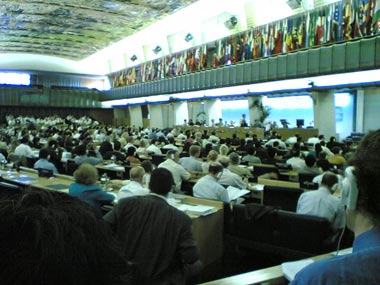
The Codex Alimentarius Commission - 85 members present
- - -
After dealing with previously submitted comments by Australia, Brazil, China and Venezuela, the vitamin and mineral supplements guideline was passed by a passive vote - no objections from a full 85-member-assembly - one item on a lengthy list of standards and guidelines to be adopted.
Here is the text of the Codex Vitamin and Mineral Food Supplements Guidelines as approved by the Codex Alimentarius Commission.
"What now?" was the question of those concerned health freedom advocates who attended the meeting, one of whom answered: "We may have lost a battle, but the war is far from over". Indeed, much now depends on the discussions recently initiated by FAO and WHO, to work out a proper model to assess the risks inherent in supplements. "But rather than only assessing the risks, they must look at the immense benefits from these nutrients as well as the risks, before they can reach a proper decision", commented another one of the activists. Agreement is building that risk assessment procedures developed for toxic chemicals cannot be applied to nutrients without making a dog's breakfast.
So where do we go from here? We must continue working to make sure that the benefits of supplements are not overlooked when deciding whether to limit quantities or composition of supplements, but this also ties in to a much larger issue: Are corporations going to decide how we should take care of our health or will people be free to choose?
There is a tough time ahead. Perhaps what is needed is a real change in health care, a reform that would sweep pharma-dominated medicine, which in the US has become the major cause of death and injury, off its pedestal of exclusive 'guardian of health' to allow all kinds of alternatives to fluorish so people may have a meaningful range of choice when it comes to health and well being.
- - -
The National Health Federation had argued the guidelines should be re-considered, because they are contravening the World Health Organization's own procedural rules, alas to no avail:(
1. The guidelines do not state what purpose they serve, although that is required by Codex rules adopted as recently as a year ago, but well before the November 2004 Nutrition Committee meeting that finalized the text.
2. There is no clear definition as to what vitamins and minerals are covered by these guidelines. Although supplements "should contain vitamins, provitamins and minerals recognized by FAO and WHO", according to the text, there is actually no publication of the FAO or WHO that provides lists of recognized vitamins, provitamins and minerals.
3. Certain countries are exempted from the application of the guidelines. Those countries that consider vitamins and other nutrients should be regulated as drugs are exempted. This means harmonization of different national laws, the goal of all Codex activity, is not being forwarded by the guidelines.
I might add that, while the guidelines ask for restrictions on supplements in the comparatively liberal countries, the really backwards view of "nutrition is really medicine and any of those nutritional supplements are drugs" is acknowledged as being quite acceptable. Indeed, one of the amendments to the guidelines was Australia's demand to emphasize that "These Guidelines apply only in those jurisdictions where products ... are regulated as foods".
Go figure.
Other articles:
The Worst Is Still To Come
By Paul Anthony Taylor
November 2005 saw the 27th meeting of the Codex Committee on Nutrition and Foods for Special Dietary Uses take place in Bonn, Germany. The Committee, one of 27 currently active Codex committees, has been meeting in Germany since its inception in 1966, and was responsible for the drafting of the controversial Guidelines for Vitamin and Mineral Food Supplements. However, and as this article will show, the most potentially damaging aspects of the Committee's attacks on natural healthcare and health freedom are still to come.www.citizens.org/
Codex Commission Adopts Supplement GuidelineCodex Full Commission adopts Codex Guidelines for Vitamin and Mineral Food Supplements in final form
KISS YOUR HEALTH GOODBYE!
Carolyn Dean, MD, ND - July 23, 2005 - NewsWithViews.com
Thanks to The American Policy Center and NewsWithViews.com our article with the provocative title, "Kiss Your Vitamins Goodbye", flooded the internet in the last two weeks of June leading up to the Codex Alimentarius meeting in Rome July 4-9, 2005. Millions of readers were on the edge of their seats waiting to learn what was about to happen. This article is a report on that meeting.FAO, WHO Go Tough On Food, Drugs Standards
Joint commission of the Food and Agriculture Organisation (FAO) and the World Health Organisation (WHO), Codex Alimentarius Commission (CAC), has moved to enforce higher global food standards. Among the measures adopted were guidelines on vitamin and mineral food supplements and a code of practice to minimise and contain anti-microbial resistance.Vitamins to be Banned Worldwide...
Opinion by Consumer Advocate Tim BolenUS CODEX Office Betrays America in Rome
"Big Pharma" versus Everybody...
Opinion by Consumer Advocate Tim BolenLeading Innovative Cancer Doc Nicholas Gonzalez, M.D. Warns Congress on CAFTA:?If the House Votes 'Yes' And Access to Nutritional Supplements Is Limited, Cancer Patients Will Sit In At Your Offices Until They Die
Lewrockwell.com: The vitamin police
Could Vitamins Be Outlawed in America?
There is growing concern among many of the manufacturers of vitamins supplements and their consumers in the United States that severe restrictions could be placed on the products they make and buy for their health if a group called Codex Alimentarius gets their way.
Any decision made by Codex supposedly supersedes national, state or local laws that may be in place according to certain world trade agreements. This is a problem in countries like the United States where vitamin supplements taken by tens of millions of Americans are readily available for people who want to purchase them on virtually every street corner. But Codex is apparently working behind-the-scenes to concoct strict rules and spread rumors about the safety of supplements as if they were prescription drugs...There are two distinct approaches to vitamins, both with nuances. One approach sees the main purpose of supplements as preventing diseases caused by deficiencies, like scurvy, beriberi and pellagra. The early quasi-official "recommended daily allowances," which have been revised only slightly, are based loosely, without allowance for individual biochemical or environmental differences, on the amounts of nutrients needed to prevent deficiencies that lead to deadly diseases.
Other researchers, including Linus Pauling (who developed the concept of "molecular disease" after DNA was discovered), Denham Harman (the free-radical theory of aging) and Roger Williams (biochemical and nutritional individuality) began to develop and test the idea that there might be levels of nutrients that not only prevented deadly diseases but improved health and ameliorated the aging process. Since the late 1950s studies have suggested strongly that the intake of certain vitamins can reduce the risk of numerous diseases, including heart disease and cancer.
From The vitamin police by Alan Bock, Sr. editorial writer at The Orange County Register on Lew Rockwell's site.
See also: Codex Animation by airlock - a concerned teenager ...
CODEX: WHAT IS IT AND HOW DOES IT AFFECT YOU AND YOUR HEALTH?
Codex is not just about nutritional supplements. In fact, it is the primary political battlefield where the war is being waged about who will regulate and control the global food supply from farm to fork. This 'war' is being waged by an increasingly tangled web of global authorities, big business and financial interests, and, as such, trade and profit are its prime goals – not human health.- - -
The industry view seems to be that "everything will be all right"...Codex Alimentarius Commission Adopts Vitamin and Mineral Food Supplement Guideline
2005-07-05 - Council for Responsible Nutrition (CRN)Codex adopts international guidelines for vitamins and minerals
Dominique PATTON in foodnavigator.comCompromise on EU Vitamins and Minerals
A legal challenge to overturn the EU's controversial Food Supplements Directive is over, but the corporate takeover of herbal medicine and natural remedies continues, writes Sam Burcher of the Institute for Science in Society.Jim Turner, the general counsel to The Weston A. Price Foundation, a charity that disseminates knowledge on nutrition, believes that Codex and the EU Directive on food supplements derive from the same basic reductionist model of western science that argues that pharmaceuticals are the only answer to health problems. World food experts refute this model by stating that natural vitamin A supplements can offer developing countries thirty times as much social improvement as one dollar of development aid.
Turner recommends that vitamin and mineral guidelines should be evaluated by nutritional science rather than the toxicological science used to evaluate toxins. Codex categorically states that nutrients should be treated as toxins and that foods and nutrients are not useful in treating disease and therefore supplements are of little value.
- - -
Jon Rappoport's take on the Codex rules for supplements just passed:
CODEX AND THE 4TH OF JULY
JULY 5, 2005. As many of you now know, yesterday Codex officially certified its own plan to limit the sales of nutritional supplements.
Yesterday was July 4.
US Independence Day.
Codex's Rome conference had been scheduled to begin on the 4th for some time.
The coincidence is too great to be an accident.
This was a piece of ritual.
"On the anniversary of your independence, we take a giant step toward curtailing your freedom."
America is the most formidable target for Codex, and Codex did not miss the opportunity to make its move on the 4th.
Codex and so-called free trade are, of course, linked. One of the faces of free trade is "harmonization" of national laws under a larger umbrella. That umbrella is being built by men who are devoted to a future in which all national distinctions and sovereignties are erased.
As I've written in these pages for four years, health and the choices surrounding it are in the cross-hairs of the globalists for a very good reason: if natural health and the means to achieve it are chopped down, what will be left are universally dispensed toxic drugs, illness, and the resulting weakness which will induce widespread passivity.
A passive population can be managed with greater ease toward ANY political goal.
A passive population can be manipulated and fooled and herded into ANY future.
Codex is an arm of that globalism which has a very specific political goal and future in mind.
In brief, it is the rule of the many by the few, behind the cover story of: "we are doing all this because we care about you and we want to protect you and help you and save you from the ruinous conflicts of the past."
You will, of course, notice that much of that language is also used by medical tyrants who seek to impose their pharmaceutical model on the planet.
It is war by other means.
Chemical war.
When at least 100,000 people in the US alone die every year from the prescription of FDA-approved medical drugs, when 2 million people each year in the US are hospitalized as a result of those drugs, and when 22 million serious adverse reactions to those drugs occur in the US every year, you can begin to perceive the outlines of this chemical war.
The single greatest resistant force to this chemical onslaught is natural health and all the strategies that compose it.
The gauntlet has been laid down.
JON RAPPOPORT www.nomorefakenews.com
- - - - - - -
And here a message about Codex from Frank - owner of the Alternative Medicine Forum Yahoo GroupDate: Tue, 05 Jul 2005 02:57:16 -0000
From: "califpacific"
Subject: Shine some virtual truth onto the codex cockroaches.Dear Group,
The major problem and mistake isn't how to combat Codex on a tactical manner by trying to fight in hearings, codex meetings, etc. because those avenues are already controlled by Codex adherents. They own the game, the rules, the players, the umpires, they already own it all and have programmed exactly how it will unfold. So how much chance do you think that we will have trying to win in a rigged game like that?
They are really winning because they are doing it in the dark. Most people in the world have never heard of Codex and if they have, they have only heard about the sanitized propaganda version put out by the codex misinformation campaign.
The only way to win this thing is what should have been done in the first place and that is to bring the truth to the peoples of the world.
You need to send that truth to all of the web page owners that you can think of because it obviously is never going to be published in the major media. It does not matter if they are vitamin oriented or not. Some of those owners are going to be vitamin takers and they personally will be affected. We may not be organized but we could put millions of guerilla fighters out there spreading truth. That is the real weapon here. They fight with lies, subterfuge, and keeping the truth hidden. We must fight with truth as our weapon. It will win.
You need to post many times a day on every internet group that you belong to the real situation and tell everyone that they are losing the basic right to even take vitamins. Don't be shy. This is some of the BIGGEST NEWS to hit the planet.
The thing that has been lacking in this fight is that the people leading this fight keeps playing into the hands of the enemy by only concentrating on playing the rigged game that is controlled by their enemies.
The real decision will be played out in the court of world opinion by the populations of each country affected, but that fight has been lost so far because those people aren't even aware of what is going on and what they are about to lose. The reason that these Codex people have been winning all along is because they are doing it on the sly and keeping most everyone in the dark about what underhanded efforts are underway. They want to keep us focused on the rigged game.
They are like cockroaches that come out under cover of darkness shielded from the light of truth. What we need to do is shine that light of truth on them. Not debate them, not play their game, but attack with the truth. Shine the light on these bastards and let everyone see them for the vermin that they are. Some of that vermin will be politicians in your own countries. You will need to shine that light on them as well.
I don't care what laws have already been passed or what they do about them. Tell them that you are no longer going to play in a crooked game that you had no chance of winning anyway. Attack the bastards day by day, every day, in the only media that was ever available to the people anyway. Attack them all over the web. Attack them a hundred times a day if at all possible. Attack them in Japanese, attack them in French, attack them in whatever languages that you can communicate in. Send the info to all of your friends that speak a different language and ask them to traslate your letter of information and then ask your friend to join the fight too.
To those web page makers and to those graphic designers out there make many banners, photos, etc. and post them on public spots so that others can use them to put on random web pages, etc. If you can write, then write something and post it around and make it available so others who have difficulty writing can use it to post all over.
You are really fighting for your lives, the lives of your families, the lives of the future members of your family. Yes, your ranks are small, but they will grow fast if the light of truth is spread to the world.
Take a few people in hand that do not know how to fight and become a band of 2, 3, 4, or 10 guerilla fighters in your band.
The message is simple and dramatic. You are losing the right to take any vitamins. It must be said over and over and over till everyone in the world is saying it too. If you are not willing to do that then set down, shut up and prepare to get in line for your Prozac, Vioxx, etc, and any other police state things that are bound to come along afterwards.Don't tell other vitamin people about it and feel that you have "done your part" Hell that is what that has been going on all along. You have to take your fight to the averge people in the streets. The streets of the internet. Every block, every house, every chat room, every bulletin board, every group, every web site, every online publication, every god damned place on the web. You need to shine the light of truth on the cockroaches that are undermining your life and undermining the health of the world.
Now get off your butts and go do something, Anything. Don't you belong to a few groups? Start there. Do you know any web page owners? If you don't it doesn't make any difference. Start there too. You don't need to know them. All you need to know is that they need to know. Write them a letter that you have prepared explaining what is going on. Send it to them and keep revising and editing your letter till it sounds great. Keep posting it to other web page owners. Keep posting it to any and all forms of media on the web. Post it to the Indy media outlets. Post it to the people motivating groups like Move on and others. Post it on every Mom and Pop web page in the world. Take a piece of virtual chalk and write it on the sidewalks and buildings of the virtual world.
You are in a fight for your lives right now, so is it going to be you or them? Now, get of your butts and do it.
Frank
posted by Sepp Hasslberger on Monday July 4 2005
updated on Tuesday December 7 2010URL of this article:
http://www.newmediaexplorer.org/sepp/2005/07/04/codex_alimentarius_adopts_vitamin_guidelines.htm
Related ArticlesCodex Alimentarius To Approve 'Vitamin Guidelines'
The Codex Alimentarius Commission (CAC) will be meeing here in Rome for a week-long conclave from 4 to 9 July, and one of the agenda points is the final approval of new world-wide vitamin guidelines that are expected to restrict availability of nutrient-containing supplements to consumers the world over. The text of the guidelines was finalized last November in Germany, by the Codex Committee on Nutrition and Foods for Special... [read more]
June 10, 2005 - Sepp HasslbergerAustralia, New Zealand - Codex Alimentarius and Trans-Tasman Harmonization
Efforts to harmonize rules on supplements between Australia and New Zealand, by establishing a Trans-Tasman joint agency for the control of natural health products have been going on for some time. I previously reported on this here, here and here. (The Tasman Sea is a large body of water that separates New Zealand from the Australian continent.) The situation "down under" really got hot when the Australian health products and... [read more]
May 09, 2005 - Sepp HasslbergerCodex 2003 - Grossklaus and Mathioudakis: Nutrition not relevant to Health
November 3-7, 2003, the Codex Committee on Nutrition and Foods for special dietary uses met in BONN, Germany, for their once-yearly come-together. On the agenda for discussion were, before baby foods and the description of healthy properties of food on labels, the proposed Codex Giudelines for "Vitamin and Mineral Food Supplements". Such guidelines would be, once passed, the equivalent of international law to be followed in all commerce of vitamin... [read more]
November 25, 2003 - Sepp HasslbergerFood Supplements: German Risk Institute Takes Dim View
The German Federal Institute for Risk Evaluation, formerly the Federal Office for Consumer Health Protection, has established a risk assessment model for deducing maximum safe levels of nutrients provided in supplements and fortified foods, according to a recent report of nutraingredients.com. The report was published in two parts, one dealing with minerals, the other with vitamins, both available in PDF format - so far only in German language (Minerals here)... [read more]
January 20, 2005 - Sepp HasslbergerGlobalizing Health - Documentary Exposes Codex, FDA, WTO Agenda
I just watched a documentary, produced by Kevin Miller, that takes up the subject of international health legislation, as promoted by the European Union, Codex Alimentarius, the FDA and other, lesser players. "We become silent" is the first comprehensive effort to bring together testimony and information about an ongoing battle for health freedom. Under the pretext of "protecting consumers", international rules are being put into effect, first in Europe but... [read more]
June 29, 2005 - Sepp HasslbergerEuropean Health Legislation, Codex And The Sustainability Of Health Care
Brussels has been busy "adjusting" EU food and medicine laws for several years now, bringing increasingly onerous controls for natural products - notably herbs and food supplements. Some observers have criticized these moves as designed to give an unfair advantage to "conventional", pharma-based medicine and will cut across preventive health strategies. Prevention is high on the agenda, but official strategies are largely limited to avoiding and killing off germs. Nutritional... [read more]
April 20, 2005 - Sepp Hasslberger


