




Chemical Poisoning: Brave New World of Zero Risk
Brave New World of Zero Risk - Covert strategy in British Science Policy is Martin Walker's latest exposé of scientific corruption. The book takes the chemical and pharmaceutical multinationals to task for bending science in the name of industrial progress and for riding roughshod over the human tragedies of people suffering injury from toxic chemicals.
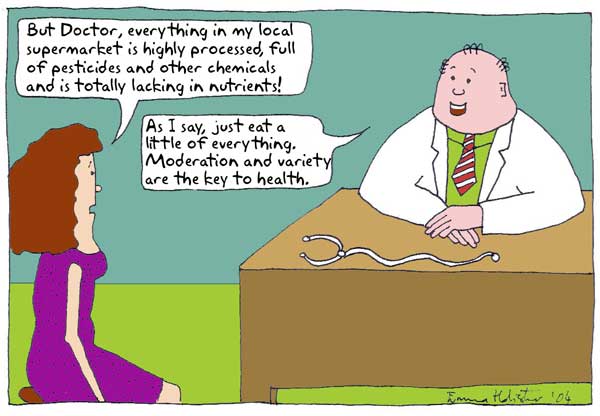
Supermarket Emma Holister
An incisive investigative writer, Martin Walker is widely known for his monumental Dirty Medicine, which documents the collusion of modern medicine with a greed-driven pharmaceutical industry. In 2004 Walker took up the fight for the chemically injured with another book, Skewed. He examines the scandalous re-definition as a psychiatric problem of Chronic Fatigue Syndrome (CFS) and a related cluster of illnesses. Walker tells of the chemical industry's collaboration with psychiatric and medical "experts" who would have us believe that physical symptoms of chemical poisoning are pure imagination and that the sufferers need a dose of psychiatric drugs and perhaps some motivational therapy.
Brave New World of Zero Risk, available here, continues where Skewed left off. But more than that - Zero Risk shows how pharma, food and chemical giants deal with those who might depress their already threatened profits even further by exposing weak points. Vaccine researcher Dr Andrew Wakefield fell from grace after finding a connection between the MMR vaccine and autism. Dr Arpad Pusztai paid with his carreer for insisting that the rats he fed GM potatos in what may well have been the only properly conducted GMO feeding experiment, suffered organ damage as a result.
- - -
Zero Risk contains extensive documentation on how front groups such as the innocent-sounding Social Issues Research Center, known for its strong support of hormone replacement therapy, are slanting the debate the way industry wishes.
"The pharmaceutical corporations can no longer be seen as a part of some social superstructure", says Walker, concluding a chapter on science and its apparently senseless direction. "Their need for a research base, for trial subjects, for organisations to agree licensing and other regulatory matters, together with their need for markets and consumers of their products, means that, like a metastasised cancer, their growth now extends into all areas of society, which has become a massive human laboratory. "The question becomes: What kind of medicine are we going to have - corporate or scientific?The quackbusters, pharma's shock troops who attack doctors that do not toe the line, are discussed with a fair bit of history and pointers to their parent organization, the so-called skeptics. 'De-bunking' activities are generally directed towards health practitioners that use cutting edge protocols such as mercury-free dentistry, nutritional immune enhancement and detoxification for chemical injury.
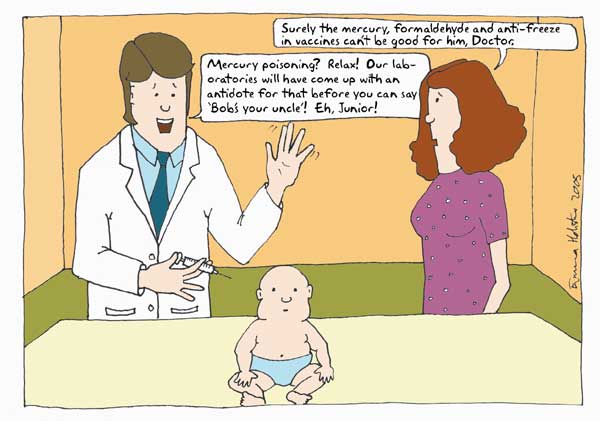
Mercury - Ralax! Emma Holister
Genetically modified foods are pronounced safe and promoted by industry groups. The decision process that led governments to the unquestioning acceptance of genetic modification as an element of science policy, according to Walker, was arrived at behind closed doors. He describes how the policy was put into effect in the UK with these words:
"In clearing the runway for bioscience, New Labour was also clearing it of its citizens. There is no room for ordinary citizens' input into the new world of science, so they have dropped them utterly from the equation, and 'steak' holders (the better fed citizens), are now the powerful vested interests..."
Evidently, people are no longer needed, except as 'consumers'. Pressure groups supplant public input with a vague concept of 'listening to the stake holders'.Covering up the harm done by industry seems to be a common practice. After citing two instances, the Spanish "contaminated oil" scandal of 1982 that killed hundreds and a 1988 Camelford (UK) water poisoning incident, where 20 tons of toxic chemicals ended up in the town's drinking water, Walker highlights the rationale behind the crazy idea that people suffering from chemical or other environmental pollution are making it all up:
"When you deny the existence of illness presented by patients, you also have to deny the mental health of those patients. So much more so is this the case with environmental illness, where the psychiatrist can first attack the very mind frame of both patient and alternative therapist. In a rational world, the subject who is affected by invisible rays from mobile phones or computer screens can be made to appear mentally unbalanced. If you can see the cause, then it is the job of crisis management, psychiatry, psychology or PR, either to convince everyone that it is not there, or disguise it as something else.""As the stakes get higher and the crack in the floodgates widens, more subtle plans have to be drafted. These are plans that start at the beginning by defining as mentally ill, those who believe that modern technological ['wonders'] can produce chronic health damage. Mental illness is undoubtedly the best fallback position for those responsible for creating environmental illness. And so it is that psychiatrists become part of the front line troops in denfence of the state and its corporate partners."
Science is being used to cover up, rather than reveal, the effects industrial 'progress' has on our health. Contrary views are rigorously suppressed. Walker says that scientists themselves have to look at how industry uses them to help suppress the evidence of harm.
"At the centre of this almost surgical censorship, which has developed like a cancer in society, are working scientists. On questions of science, it is imperative that scientists themselves wise up to the way in which they and their work are being manipulated."Caught your interest yet? You can download the PDF of Martin Walker's book. Don't forget to leave a small donation. Walker provides his work for free, but he does need to eat as well...
If, instead, you want to get an even closer look at the subject matter, here is a message from Emma Holister, artist and campaigner for health, who forwards a recent essay by Martin titled "Realpolitik and ME", which you find below.
- - -
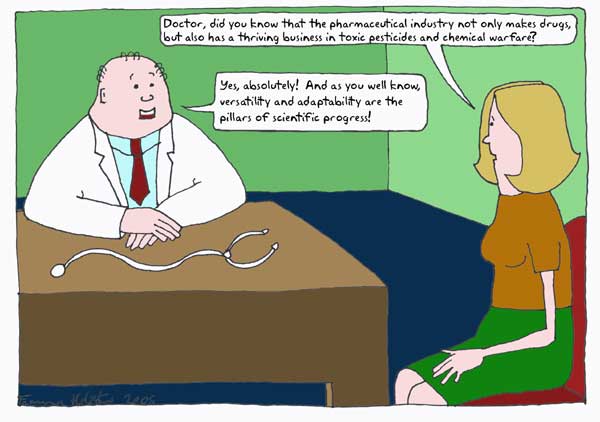
Chemical warfare Emma Holister
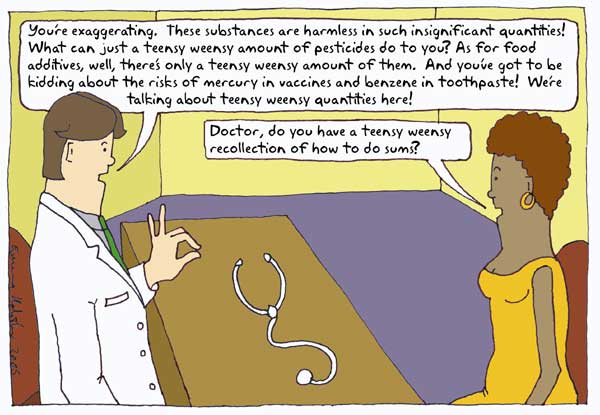
Teensy weensy Emma Holister
Here is Emma's message:
Martin Walker once again takes us on a guided tour along the sordid money trail of pharmaceutical funding that fuels the psychiatric lobby's defining of M.E. [Myalgic Encephalopathy] as a psychiatric condition rather than an organic illness.
I consider my own illness, Candida, to be a cousin of M.E., as it is also caused by chemical injury. Those chemicals/drugs are the massively profitable products of the very same chemical and pharma companies who are relentlessly defining these illnesses as psychiatric conditions for which they recommend yet more of their lethal products, anti depressants. Candida is treated as both a 'minor fungal infection' and a stress related psychiatric disorder by most of the medical profession. It is also a major source of profit in the pharma AID$ industry, candida being one of the most common ailments of 'AIDS' sufferers.
As these issues are so close to my heart and personal campaigns I have included some cartoons that I feel are related.
Emma xxx
- - -
8 November 2005
Realpolitik and ME
By
Martin J. WalkerWe live in a period where everything is spin, where the truth is rarely told about public policy and where many public arguments are disingenuous. However, during the contemporary period, everything is confusion. Only when we look back are we able to see clearly how social reality was constructed.
This situation makes it very difficult for campaigners, or those trying to voice a dissenting view to Government or its agencies. While thirty years ago, it might have been possible to engage in a peripheral dialogue with government, today, government and its many agencies is a secretive, shadowy organisation which often invites campaigners to wrestle with phantoms. In contemporary society, there is, in short, no point at which the clear demands of the people might be put to government and a considered answer returned.
One of the principal reasons for this is that over the last fifty years, the government has begun increasingly to act on behalf of hidden constituents. Instead of gauging and responding to the needs of the people, they have increasingly, in the field of health, begun to act on behalf of corporations, foisting their demands onto the public in the form of policy. In some areas, this corporatisation of government is easy to see and describe, in others, it lies deeply hidden and anyone who attempts to unravel it is quickly accused of advocating ‘conspiracy theories’.
The campaign to de-construct the neurological illness ME, to ridicule its sufferers and, in the process, to redefine a growing body of ‘mentally ill’ subjects, began in the mid eighties. The principal character in the British campaign has been Professor Simon Wessely. Over time, however, the ‘psychiatric lobby’ has gathered new adherents and a large, increasingly organised body of combatants.
The psychiatric lobby is now marked by its financial power – over 11 million being funnelled into the network of clinical centres and funding provided by the Medical Research Council (MRC) to carry out the PACE and FINE trials; its roots in major medical research institutions like the MRC and increasingly its links to corporate lobby groups funded especially by the pharmaceutical companies.
The patient, or ‘sufferer’ group which has been forged simply by its opposition to the psychiatric lobby, has inevitably consisted of disparate groups and individuals. Inevitably, because unlike the psychiatric lobby, this grouping has no common ideological purpose nor does it have a hegemonous leadership. Mainly, as well, this group is composed of people who are ill or their carers, circumstances which leave little room for organised campaigning. The only two defining criteria of this group are, first, they seek effective treatments for ME and second, they have pressed the research community to carry out physical research in order to find the organic causes of ME.
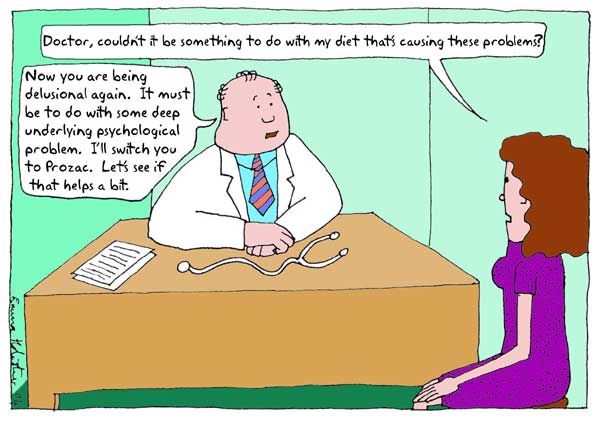
Delusional Emma Holister
While the psychiatric lobby is well organised, powerful and educated to a unified purpose, sufferers, patients and their families lack political, organisational cohesion. The inability of this ‘community’ to form a united political campaign has meant that they have faced a consistent series of defeats, and while the ‘psychiatric’ lobby has become stronger, the campaign of sufferers, patients and their families have lost ground, broken off on the edges and become divided within itself.
ObjectivesWhat is inevitably confusing about the psychiatric lobby, what makes them difficult to stand firmly against, is their apparent lack of a reasoned and ultimate objective. It is, of course, useful to define ultimate objectives in order to organise opposition strategies. While an effective campaign can be waged on a day to day basis, it is an understanding of the final objective of the psychiatric lobby which should in principle define the political movement against them. Without any understanding of the lobby’s objective, we are left to weigh up each new assault, each new gambit, on the apparent sincerity of its proposer.
Before going on to look at the present strategies being employed by the psychiatric lobby, I would like to try and define their long-term objectives.
With New Labour, the biotech industry and the pharmaceutical companies have planned a far-reaching programme of ‘drug’ research. They are committed to being world leaders by the year 2015 in the production of biotech and genetically engineered ‘person altering’ substances. These substances will not be medicines in the sense that we recognise them presently and the purpose of many of them will not be to treat illness. In fact, it might be the case that we have come to the end of the period of human pharmaceutical drug use, at least on the scale we have witnessed it over the last fifty years.
These new patented substances will be used primarily to change people. Apart from a number of physical changes, there are many mental outlooks which might be affected: a person might be made happier, more serious, more creative, to have, for example, a better memory, or to be more empathetic, more attractive to the opposite sex.
Presently, the pharmaceutical industry, which has recently begun to join with the biotech industry, considers that it suffers over-regulation. Limitation on animal experiments and strictures on human drug trials are increasingly considered an obstacle to profit. The big problems, however, lie in the future: Will these corporations be able to convince governments - in the face of anti-vivisection protests – that the rules for animal testing can be stretched to include mood-altering compounds which are not specifically ‘treatments’? Even if this problem is resolved, in second stage testing, corporations are going to need considerable access to human volunteers, particularly those with certain psychological portraits.
I can see no other reason why the North American State has embarked upon a mental health audit of the whole population, nor why British psychiatrists should want to push half a million adults and children through a network of clinical centres which evaluate their psychological status.
The Ongoing BattleWith this possible long-term objective in mind, we can return to reviewing the psychiatric lobby’s present strategies. The battle between the psychiatric lobby and the vulnerable patients and sufferers campaign has always been a massively uneven battle. Fairly recently, however, it has taken a major turn in favour of the psychiatric lobby.
The report of the Chief Medical Officer in 2003, ultimately only strengthened the hand of the psychiatric lobby, awarding them even greater funding to carry their case forward. However, because in some general respects this Report gave powerless succour to patients and patients groups who had been arguing that the origins of ME were organic, the report angered the psychiatric lobby. Weeks before the end of deliberations, in an infantile gesture, the psychiatric participants resigned en masse.
Since the end of the CMO’s Report, the psychiatric lobby strategy might be said to have four prongs.
The PRIME Project and PACEThe PRIME Project appears to be giving the kind of time and attention to ME sufferers which many of them have always wanted. However, despite its protestations that it is evaluating the kinds of treatments best used with ME, the project is nothing more than a softening-up project, working to shovel sufferers into the PACE trials and its network of clinical centres.
The PRIME Project is firmly rooted in the camp of the psychiatric lobby and has no intentions of either raising the funds for or designing any programmes of organic research into the causes of ME. The complete exposure of this strategy is written up on the One Click site in The One Click Story – The Underbelly of ME/CFS Politics Revealed.
Assault on the Political OppositionThe third strand of the strategy has involved an all-out assault upon the One Click campaign, the only patient advocacy group opposed to the psychiatric lobby which has a political perspective. This assault has been varied in its implementation, including, character assassination, threatening letters, police intervention, arrests, the interference with telephone and computer services and, in the case of [One Click founder] Jane Bryant, the confiscation of her computer. It has been singular, though, in its objective, to shut down the principal opposition to the psychiatric lobby. This strand of the strategy is also written up on the One Click site.
The ‘Independent’ InquiryThe fourth strand of the strategy, which has emerged over the last six months, has exhibited itself in Dr Ian Gibson MP’s ‘Independent Inquiry’, which was set up to examine other than psychiatric causes of ME.
The emergence of the ‘Independent ‘ Inquiry manifests one of the greatest differences between the two lobbies involved in this ongoing battle being fought over ME sufferers. The philosophy of those who are asking for serious scientific biological research into the causes of ME, can be reported simply and without embellishment. For twenty years now, they have wanted no more than any other patient group in Britain: to raise the issue of, and the funding for scientific research into the cause and treatment of their condition.
With respect to those who maintain that ME is first and foremost a psychiatric condition, their philosophy, its campaign and their strategies have been anything but straightforward. Baroque in its intrigue, infinite in its dissembling, practised like a card sharp in deceit, it has resembled nothing less than a psychological operation constructed by the CIA or some other secret policing instrument. The campaign has buried itself inside medical research like an engorged maggot; at every turn, new money comes to hand, more mercenary researchers rush to its aid. With each turn of the ratchet in its offensive, new sponsors from the corporate world emerge, new velvet gloves hiding iron fists, new words of reconciliation which conceal venom and forked tongues.
Because the patient community is unable to adopt a cohesive political line, they get duped every time the psychiatric lobby hides its stick behind a large carrot. In the case of the phantom ‘Independent’ Inquiry, Dr Ian Gibson New Labour MP for Norwich North, approached Kevin Short and Professor Malcolm Hooper. After a discussion Gibson went to the nearest phone box and having changed into his familiar red and blue suit, flew out exclaiming; ‘It’s about time something was done, I will set up an Independent Inquiry’. Within days of Gibson’s offer, Short was energetically digging another hole for ME groups to bury themselves in.
Neither Kevin Short nor Professor Hooper, or for that matter a number of others who quickly tendered evidence to what has turned out to be an entirely bogus offer, seem to have given Gibson’s offer a moment’s political reflection. It was as if the words ‘Independent Inquiry’ mesmerised the listeners and they immediately suspended their political judgement. ‘I’m an MP’, said Gibson, ‘trust me’.
Had either Professor Hooper or Kevin Short reflected for a moment on Gibson and his offer, they would have found cause to be concerned. Before he became an MP, in 1997, Gibson was Dean of the School of Biological Sciences at the University of East Anglia (UEA). East Anglia was the base, until the mid nineties, of Fisons, the agricultural chemical company. Funding from the company helped shape research at the UEA, more so when Fisons was bought up by Rhone-Poulenc in 1996. In 1999, Rhone-Poulenc joined with Hoeschst Marion Roussel to form Aventis. UEA has had a funding input from all these companies and, in 2003, it was in the top twelve Universities receiving funds from the BBSRC, the bio-tech quango which dispenses massive funding – some of it from the coffers of the Sainsbury family. Gibson himself has declared funding received from Rhone-Poulenc for taking part in scientific meetings.
Up until last year, Gibson was the Chair of the All Party Science and Technology Committee (APSTC), the watchdog committee which oversees science policy in the Commons for the Science Ministry which is situated within the Department of Trade and Industry (Dti). The APSTC is funded in part by Astra Zeneca, the Dti and bioscience companies.
Together with Dr Des Turner, Tony Wright and Dr Richard Taylor – also a member of the Associate Parliamentary Group on Health, set up by the pharmaceutical lobby group Networking for Industry – Gibson is a member of the All Party Group on Cancer, which is heavily funded by all the leading Big Pharma names, including Novartis, Pfizer Lilly and Merk. He is also a member of the All Party Group on Pesticides and Organophosphates, which, until they became more focussed on bio-engineering, were staple product of Fisons and Rhone-Poulenc.
Gibson is a leading member of the British Association for the Advancement of Science, now called simply the BA, which in the early nineties played a considerable role in promoting the ‘quackbusting’ Campaign Against Health Fraud. Gibson sits on the editorial committee of the BA’s magazine, Science and Public Affairs, the magazine is again a public arbiter of government science policy and Gibson shares his editorial role with personnel from the Royal Society of Spin, The Financial Times, the Parliamentary Office of Science and Technology (POST) – the science policy-making centre of government, and the Wellcome Trust.
Involvement in the higher echelons of corporate science and government has brought Gibson into contact with the new generation of science lobby groups. Sense About Science – funded by the ABPI and various chemical and pharmaceutical interests; The Institute of Ideas – funded by Pfizer and the Science Media Centre, also funded by the ABPI and a variety of powerful corporations. These lobby groups work in partnership with New Labour, POST and the Dti.
Although they profess a focus on science, these groups, are actually involved in corporate PR and spin. They are linked in North America to right-wing libertarian groups heavily involved in ‘quackbusting’, campaigning rabidly against alternative medicine, environmentalists and patient advocacy groups. In Britain, they have been involved, in partnership with the Royal Society and the Royal Institution, in pushing corporate interests in Genetically Modified crops and pharmaceuticals. In 2004, Science in Society, the magazine of the Institute of Science in Society, one of the most independent and radical science campaigning groups, informed its readers of the collusion between Professor Derek Burke a leading member of Sense About Science, and Dr Ian Gibson, in defending GM crops on the grounds that they were perfectly safe for human health.
This interest in corporate science is, of course, quite natural for a man who has been an academic scientist prior to entering the Commons. For ME sufferers, however, Gibson’s involvement with the various groups above must sound alarm bells. As I explained in Brave New World of Zero Risk, the lobby groups which are presently spinning news on behalf of corporate interests and New Labour are the joined up version of the quackbuster group HealthWatch (in fact, members and ex - members of HealthWatch actually write unattributed copy for members of these lobby groups).
One of the prominent founding members of HealthWatch was Simon - now Professor - Wessely. Wessely is now a senior member of the Science Advisory Panel for the Science and Media Centre, a member of the US American Council on Science and Health advisory panel, a leading member of the R,RSA, an obscure group inside the Health Protection Agency, set up to spin all public health threats, and he is still deeply involved in the corporate manipulation of ME information. Yet another prominent member of this new generation of Lobby organisations is Michael Fitzpatrick, an East London GP who has written in purple prose about false beliefs held by people who claim that they have the physical symptoms of ME.
The fact that the ‘Independent Inquiry’ into the skewing of government policy on ME towards the psychiatric lobby, which Gibson promised, turns out to be neither an ‘Inquiry’ nor ‘Independent’, is par for the course. Before even the composition or the personnel of the Inquiry had been announced, the Independent Inquiry suddenly metamorphosed into a ‘Scientific Group on ME’ situated in the offices of Tony Wright MP, the last Chair of the Parliamentary group on ME.
So, after twenty years of getting by on a wing and a prayer, without the slightest evidence to support their bizarre belief that ME is a psychiatric condition, the psychiatric lobby has wised up. How much better it would be for the psychiatric lobby to colonise the area of physical scientific research into ME. Of course, there is a vast difference between gathering information about scientific research into ME – little of which has been done for obvious reasons – and supporting this same research.
We have a good example of how the corporate science lobby groups deal with scientific research in the position that Dr Fitzpatrick and others have taken on Dr Andrew Wakefield’s research. There is only one genuinely scientific resolution to an argument within scientific research, that is, to independently replicate research and compare results. Instead of doing this, the ‘science lobby’, supported by government and pharmaceutical companies, used research reviews like the recent Cochrane Review, which compared studies focussed either on MMR or Autism, to discredit Wakefield.
Inevitably, there has been precious little physical scientific investigation into ME, in Britain. The reason for this is obvious; all the money and the power is held by the psychiatric lobby the posturing of which, over ME suits the government and the corporations. Once again, with the declaration of an ‘Independent’ Inquiry, the ME community has been thrown into confusion by a honeymoon offer from their detractors. The singular lack of political analysis amongst some of the most prominent figures in the ME community, has yet again led these long-suffering individuals down another blind alley.
The conflict between the psychiatric lobby and those who believe that ME has a physical aetiology is now intractably dominated by vested interests. The PRIME Project, the ‘Independent’ Inquiry and the network of clinics set up by the NHS, under the guidance of Professor Pinching, all constitute major advances by the psychiatric lobby. Unfortunately, after twenty years of denigration, many ME sufferers and their carers are still avoiding crucial political questions and failing to work autonomously towards what should be their two main objectives.
The first, a political objective has to be the organisation of a far reaching independent and judicial investigation into the psychiatric lobby and, the second, more practical objective, the establishment of an ‘independent’ national research fund, which will be used to establish and conduct research entirely into the physical causes of ME by medical researchers unaligned to either corporate or psychiatric interests.
There comes a time in all political struggles when accepting the hand of friendship from a suspected or traditional enemy, or even entering into a dialogue with them is simply to commit Hara Kiri, in public without the honour. Until the ME ‘community’ has built a solid and cohesive movement opposed to the psychiatric and corporate lobbies, until they begin to close in on either of the two objectives above, it would appear wise for them to adopt the ‘precautionary principle’ and maintain a moratorium on listening to or consorting with anyone who comes bearing gifts or ‘Independent’ Inquiries.
Martin J. Walker
8 November 2005Martin Walker's book: Brave New World of Zero Risk Martin Walker provides the book for free. Your contribution is welcome - it will help him continue his excellent investigative work.
See also:Liberating Knowledge
The western knowledge that dominates the world today is in crisis across all disciplines, with science being the worst afflicted. Reliable knowledge is being drowned out by relentless propaganda and a concerted disinformation campaign aimed at promoting the commercial products of knowledge, while critical information on the dangers involved is summarily dismissed and suppressed. Worst of all, knowledge is being privatised and contained as the "intellectual property" of corporations, giving corporations unprecedented control, not just over knowledge of nature, but over life and the necessities of life. Liberating knowledge is the most urgent task facing humanity, without which there can be no reliable knowledge freely accessible to all ...New test identifies mysterious disorder
According to the Statistics Canada 2003 Canadian community health survey, some 341,126 Canadians have chronic fatigue syndrome, a debilitating disorder characterized by extreme, long-lasting exhaustion and flu-like symptoms. Since it was identified in 1984 by Drs. Dan Peterson and Paul Cheney in Incline Village, Nev., the syndrome has been accompanied by confusion and controversy. Many people -- including some health-care professionals -- don't believe it exists, attributing the symptoms to a variety of other causes, ranging from influenza to depression.
posted by Sepp Hasslberger on Thursday December 22 2005
updated on Thursday December 16 2010URL of this article:
http://www.newmediaexplorer.org/sepp/2005/12/22/chemical_poisoning_brave_new_world_of_zero_risk.htm
Related ArticlesMultiple Chemical Sensitivity: Enzyme Related Toxic Overdose
More than 200 diseases have been linked to pollution by a recent study, according to an article published in The Independent. Although it has been known for some time that increased cancer incidence is linked to pollution, it is seldom we see an open acknowledgement in the mainstream press that we are actively poisoning ourselves with chemicals and other pollutants released freely into the environment. Those substances are so ubiquitous... [read more]
November 16, 2004 - Sepp HasslbergerMercury, Autism, Chemical Sensitivity - New Study Gives Hope
Autism has taken on epidemic proportions without any clear signs as to what causes the illness. While there is much data that links vaccines and especially the mercury contained in them to autism, a report released by the Environmental Working Group (EWG) on 13 December seems to bring us a step closer to the truth. As Dr. Mercola points out, the report cites a specific metabolic impairment in autistic children... [read more]
December 19, 2004 - Sepp HasslbergerCFS is Heart Failure Due to Mitochondrial Malfunction
An article found on the Alternative Medicine Forum explains the mechanism behind Chronic Fatigue (CFS) in terms of the function of mitochondria's cellular energy production cycle. A definite must read for anyone who suffers exhaustion and fatigue that cannot be explained. "I think this is one of the most important handouts I have ever produced in terms of my understanding of CFS and what to do in order to recover!... [read more]
November 10, 2005 - Sepp HasslbergerAIDS, Chronic Fatigue: Modified African Swine Fever Virus Implicated?
What do people suffering of AIDS and those suffering of CFIDS - chronic fatigue and immune dysfunction syndrome - have in common? Apparently more than immune trouble. There is a virus that seems to be present in both, but is almost never tested for. HHV-6A, thought to be a genetic cross between Cytomegalovirus and African Swine Fever Virus, is found in both AIDS and CFIDS patients. HIV instead, a relatively... [read more]
April 28, 2005 - Sepp HasslbergerPesticides too harmful to use in any form, doctors warn
""The review found consistent evidence of the health risks to patients with exposure to pesticides," the study said, naming brain cancer, prostate cancer, kidney cancer, pancreatic cancer and leukemia among many other acute illnesses. As well, the college found consistent links between parents' exposure to certain agricultural pesticides at their jobs and effects on a growing fetus ranging from damage to death. The risks, they concluded, can come even from... [read more]
April 29, 2004 - Chris GuptaWreaking Havoc in our Biosphere
Pesticides have become a way of life, but really they are poisoning not only the intended victims - mostly mosquitos - but other insects we consider beneficial - as well as animals and ultimately ourselves. The "chemical way" clearly shows its limitations. Beyond Pesticides has a report on this. Communities across the country are stopping their use of pesticides and adopting preventive strategies that manage mosquito breeding areas and educate... [read more]
August 02, 2003 - Sepp Hasslberger


