




Asian Vultures Face Extinction: Anti-Inflammatory Diclofenac Culprit
Vultures in India, Pakistan, Nepal and other South Asian countries have been decimated from being the 'most common large bird of prey' just two decades ago, to hovering at the brink of extinction. More than 95 % of the vulture population has disappeared, before we took notice. The reason is an anti-inflammatory drug, commonly used in livestock, such as cows. The drug's residues destroy the liver of the birds that feed on the carcasses of treated animals.
The cause of the great dying was found just over a year ago, according to a BBC report, which fingered diclofenac, a non-steroidal anti-inflammatory drug whose veterinary use on livestock in South Asia has grown rapidly in recent years. The Indian government is in the process of prohibiting the use of diclofenac on livestock. A paper recently published by the Public Library of Science (PLoS Biology) proposes to switch to another, less damaging anti-inflammatory: meloxicam. When fed to vultures, the drug did not have visible negative effects.
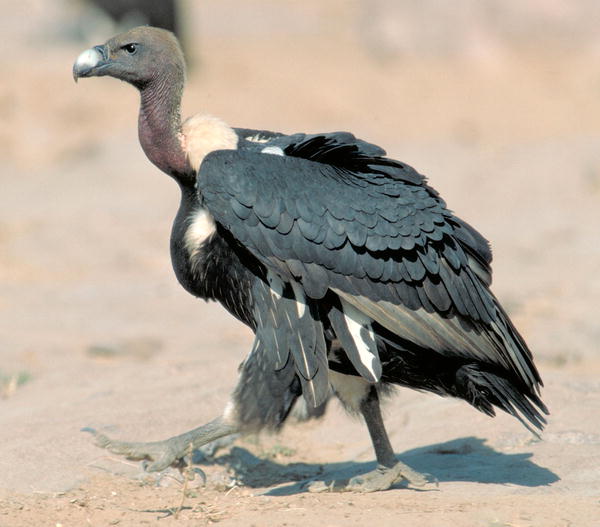
Image credit: Goran Ekstrom/PLoS Biology
Another possible way of protecting wildlife - not only the vultures we see vanishing in the space of a mere decade or two - would be to switch not drugs but agriculture, to change from the chemical paradigm prevalent today to biological agriculture, where life is not exposed to potentially deadly toxins. But that does not seem to be part of the Indian authorities' plans, at least for now.
A synopsis of the study describing what happened and why is available from PLoS:
- - -
Switching Drugs for Livestock May Help Save Critically Endangered Asian Vultures
In just ten years, tens of millions of vultures have vanished from the Indian subcontinent. Since the early 1990s, white-backed (Gyps bengalensis), long-billed (G. indicus), and slender-billed (G. tenuirostris) vulture populations have dropped by over 95%. In Europe, it was clear that human persecution eradicated bearded and griffon vultures from some countries (reintroduction and protection efforts are now restoring populations). But in India, where it is illegal to kill wildlife and the bird is valued for its ecological role, their unprecedented decline was puzzling. Dead birds found in India, Pakistan, and Nepal had extensive visceral gout (a buildup of uric acid crystals in the internal organs associated with renal failure). The birds often appeared sick and lethargic, some showed prolonged severe neck drooping, before collapsing—sometimes from their perches...
See also:Removing the Threat of Diclofenac to Critically Endangered Asian Vultures
(the full text of the study as published on PLoS biology)Vultures under threat worldwide
Scientists formulate Indian vulture rescue plan
Bird groups hopeful on vultures
posted by Sepp Hasslberger on Friday February 3 2006
URL of this article:
http://www.newmediaexplorer.org/sepp/2006/02/03/asian_vultures_face_extinction_antiinflammatory_diclofenac_culprit.htm
Related ArticlesChemicals Better Than Nature? - Perhaps Not
A recent report from the UK-based group Sense About Science titled Making Sense of Chemical Stories challenges the concept that natural is better for our health than chemical. Chemical substances are often safer than natural ones and are being unfairly blamed for cancer and other illnesses, the report says. Those suffering from Multiple Chemical Sensitivity/Chronic Fatigue Syndrom (MCS/CFS) would disagree. Sometimes one heavy exposure to a toxic substance is enough... [read more]
January 28, 2006 - Sepp HasslbergerFood Safety: Codex Backs World GM Experiment - Could AFRICA Be Control?
Food is of crucial importance to good health. The international food code, also called CODEX ALIMENTARIUS, was set up in the 1960's, ostensibly to promote the safety of foods. But recently, Codex has come up with an extraordinary piece of advice: "Be careful about those nutrients." A Codex Vitamin and Mineral Food Supplement Guideline adopted by the Codex Alimentarius Commission in Rome in July this year says just that. On... [read more]
September 15, 2005 - Sepp HasslbergerChemical Poisons Cause Increasing Levels Of Illness - Tobacco Blamed
"Low levels" of chemicals, from toxic mercury in tooth fillings, foods and vaccines, from hexafluorosilicic acid, an industrial waste product, added to our drinking water, to herbicides and pesticides in vegetables and fruits as well as mosquito spray liberally distributed in the air, are ever increasing and according to some are to be blamed for rising levels of illness. Interestingly, tobacco smoke takes all the blame, as it has since... [read more]
August 02, 2005 - Sepp HasslbergerThailand: World Health Organization Urges Research Into Safety Of Transgenic Foods
In what seems to be the first high level admission that we really don't know whether genetically modified foods are beneficial or damaging to health, the World Health Organization's Food and Agricultural Organization (FAO) has called for more research into the health risks possibly posed by transgenic foods. While consumer rights activists called for application of the precautionary principle, already in force for environmental toxins, to transgenic foods, FAO's assistant... [read more]
October 14, 2004 - Sepp HasslbergerAgriculture: Chemicals GMO Failing - Try Organic, Sustainable
A recent discovery presages production of hydrogen - not by electrolysis but by the effects of catalytic action and sunlight on water. In the ensuing discussion on this post, the question turns to what would be needed to afford economically decent conditions to the billions of people in developing countries. It appears that both water and energy will be important, but even more decisive than these factors will be low-input... [read more]
October 09, 2004 - Sepp HasslbergerMillions of bees dead - Bayer's Gaucho blamed
Synthetic honey and GMO bees - Part II A French governmental report confirms suspicions of a mass poisoning of bees involving hundreds of thousands of colonies of honey bees. According to the report of the French Scientific and Technical Committee, Bayer's seed treatment GAUCHO pesticide is to blame - at least in part. Earlier this year, I published an article by French journalist Michel Dogna, who had investigated the ecological... [read more]
November 26, 2003 - Sepp Hasslberger


