




Hormone Replacement: The Symptoms of Menopause
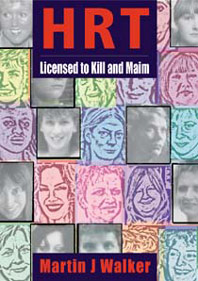
Martin Walker, the author of "Dirty Medicine", has recently published a book on Hormone Replacement Therapy, titled HRT - Licensed to Kill and Maim. My copy of the book was sitting on the shelf for some months before I finally got to crack it open, more out of a sense of guilt rather than genuine interest.
HRT Licensed to Kill and Maim.
(Slingshot Publications)
But I was mistaken. Walker hasn't written just another dry condemnation of a form of treatment that was widely promoted and then turned out to do more harm than good. He brings the suffering of the women on this therapy to life in a very real way, and he links the story of the failed hormone drugs to the larger reality of today's pharmaceutically controlled medical caste which has become the sales machine for rich pharma multinationals, rather than a source of comfort and healing for individual patients.Imagine my surprise when I read the headline of a recent Daily Mail article: HRT scares 'have been a catastrophe for women's health'. The author Jenny Hope implies that Hormone replacement was unjustly criticised saying: "One million women are 'suffering unnecessarily' after turning their backs on HRT because of health scares, say doctors." After estimating that HRT prescriptions in the UK have fallen from two million to one million, the article quotes Dr John Stevenson of the Royal Brompton Hospital in London, who says: "A million women are suffering the consequences of not being on HRT. Women now coming into the menopause are too scared to go on to HRT. It is a disgrace."
Of course Dr Stevenson completely ignores scientific studies that have found HRT to be outright dangerous:
The Women's Health Initiative randomized controlled trial scheduled to run 8.5 years was abruptly halted at 5.2 years because women in the treatment group had a 26% increased risk of invasive breast cancer.
He also ignores the extreme plight of women suffering at times terrible and life-changing side effects of a hormone overdose prescribed by their doctor and even at times administered without consent by implant. So is the article merely an attempt by pharmaceutical PR departments to revive a dead therapy?
One might be tempted to think so, especially in view of another recently published study reported on in BBC News, that found HRT increased heart problems, instead of helping. There seems to be no shortage of studies with scary results implicating hormone replacement in serious and at times deadly side effects. But business is business - hey, if some women who take the drugs feel better, who cares about all the rest?
Well, we really should care, says Martin Walker, and he explains why in his book:
- - -
HRT Licensed to Kill and MaimMartin Walker's book is a 'must read' for any woman deciding whether to start hormone replacement therapy or find other ways to cope with the coming life changes. We should learn from past mistakes and Walker's book does a good job bringing into view the mistakes of women who have put their trust in medical doctors and public health officials to guide them in their choices:
Almost all the problems with HRT are created in the space between scientific theory and human practice. The claims of manufacturers, distributors, marketing men and physicians for HRT, in thousands of instances, take no account of the reality of doctor-patient relationships, medical practice and the non-conforming diversity of women's physical and psychological make-up. It is this last aspect that turns HRT from what seemed like 'a good idea at the time' into the most dangerous of therapies.The supplementation of the female body with hormones to avoid or ameliorate a natural life change is fraught with moral, ethical and technical dilemmas. The moral and ethical questions loom over the production and consumption of HRT, casting doubt on the very motive and direction of medical science in respect of women. Unfortunately science and medicine have slipped the hawsers of ethical debate in this area, turning the issue into a medical question in which the only criterion is a slight and putative improvement in health.
Dr Stevenson, as quoted in Jenny Hope's article, is not alone in his defense of Hormone replacement. Even as the news of damaging effects in the studies about hormone replacement broke, pharma supported patient groups and prescribers of HRT raced to put out the fires:
In calling off the Million Women study and urging more care in the prescription of HRT, the British Government contrived to give the impression that, while doctors had hitherto been circumspect in their prescribing, they would now be positively stringent.The reality, however, was quite different. At a later date, Dr Maureen Baker, honorary secretary of the Royal College of General Practitioners and a supporter of HRT, speaking of the number of women using HRT over lengthy periods, said "I understand that about 20 per cent of women have stopped taking HRT, but that is likely to include many who have been on it for years and did not really know why they were still taking it." This statement, perhaps more than any other made during 'the HRT crisis' at the start of the new millennium, speaks volumes about the attitude of physicians towards their patients and towards pharmaceuticals.
Dr Philip Sarrel, Emeritus Professor of Obstetrics and Gynaecology and Psychiatry at Yale University School of Medicine, reacting to findings of the Women's Health Initiative, was similarly relaxed about the dangers of hormone replacement therapy, taking the view that new study results did not mean that women should give up on HRT. "The paper does help guide women and their physicians in being selective in a choice of hormone therapy", he said.
Pharmaceutical companies have been accused of "disease mongering", a term for the promotion of quite normal life conditions as somehow in need of pharmaceutical intervention. "HRT is used to combat symptoms of the menopause, including hot flushes and night sweats, with a range of drugs including tablets, implants and patches", writes Jenny Hope in the Daily Mail. Notice the term "symptoms of the menopause", as if the menopause were an illness rather than a period of transformation in every woman's life. Perhaps HRT was one of the earliest examples of pharmaceutical disease mongering.
There is an almost unbridgeable gulf between the theories of medical science and the practice of corporate drug pushing, between human communities and pharmaceutical corporations. Rather than researching, treating and curing long-established illnesses, pharmaceutical companies - 'inadvertently' aided by the processed food industry's manufacture of junk foods, and by other environmentally toxic industries, together with their own manufacture of adverse reactions - now create new illnesses and markets, which their drug development divisions can research.Martin Walker's book revolves around the story of one woman, Maggie Tuttle, who suffered immensely from Hormone medication but who, being a campaigner, immediately went to initiate a patient self-help group she called the Menopausal Helpline. Over ten years, she had over ten thousand contacts from women who suffered similarly, and she attempted to work with pharmaceutical manufacturers and medical societies to bring about changes. Her communications were blocked at every turn, her group denied all support and eventually, the effort became too great so the help line folded.
Other groups that agreed to listen to the hormone 'experts' and accept money from pharmaceutical manufacturers fared much better by comparison:
The British Menopause Society is just one of a global network of societies that all advocate HRT to a great swath of the world's female population. All of the societies and their activities are funded by a variety of pharmaceutical companies. None of the societies discusses, in any serious way, either alternative remedies or a natural, non-medicated path through menopause.All the societies, despite any debate about the details, are heavily committed to selling HRT to the menopausal population. The consultants who speak for the societies propose that women try HRT as a first option. More disturbingly than any of this, the clutch of male consultants who direct the policy of the societies, all defend HRT and consistently write against studies that appear to suggest that the drug regime might damage women.
The most prominent consultants based as council members within the British Menopause Society, whose writings are used for many other foreign societies are: David H. Barlow, Timothy Hillard, David W. Purdie, Anthony Seeley, John Stevenson, Professor John Studd and David W. Sturdee.
As soon as the 2003 study results became available, the British Menopause Society quickly set up meetings with other societies, with the intention of making a series of statements that would stabilise the consensus view of HRT.
In the last chapter of his book, Walker attempts to flesh out his view of an ideal society, something to compare today's damaging medical treatments to, so as to start our with an ideal to work towards, not only a bad situation we want to get away from:
My 'other' starting place is one where we accept into our bodies none - or the absolute minimum - of the chemical toxins prescribed for us. It is one where we enjoy nutritious and, as far as is possible, organic fruit and vegetables...This other place is one where we try to control our immediate environment as best we are able, so as to exclude environmental toxins...
My ideal place is one where, from an early age, we gain as much information as possible about our bodies and how they work; a place where we try to understand how to respect our bodies and treat them with the various healing arts. It is a place where we take what is best from our collective culture and history, and repudiate the violence and emptiness of commercial culture.
Martin Walker wonders why medical culture has so far escaped censure for its actions, despite clear evidence linking treatments and pharmaceutical drugs to damaged health outcomes. A point that struck my mind is that we do have a profession that really is charged with finding out where illnesses come from, but the members of that fraternity are strangely silent on physician-induced illness:
It is to link illnesses with their causal agents that we have epidemiologists. For some obscure reason, however, while epidemiologists help in moving heaven and earth against the butcher, fishmonger or sandwich bar owner who gives even a couple of individuals a salmonella stomach upset, they seem not to operate in the area of drug damage. While the greatest of them will work assiduously for years on behalf of corporations, proving that their products could not possibly damage anyone, few, if any of them, will work on behalf of local communities, and next to none of them, apparently, in community epidemiology.Perhaps this pointer will help us bring about reforms of medicine that are urgently needed, and to change the course of pharmaceutical business into a path less damaging to our collective health. Educating physicians about and making them responsible for the damage they may be doing by prescribing would be part of the solution.
Despite the title and the subject matter, Martin Walker's book is not only for women. Every man who lives with a woman or loves one better read it lest he lose his love to the snares of doctor-induced (iatrogenic) illness. Readers will certainly be applying the lessons of this book to their own lives - be more careful when you next meet your doctor - and hopefully the essential message will spread like wildfire: Take your health in your own hands!
Related article:Wyeth’s First NJ Prempro Trial Begins Today
This latest case involves Ellen Deutsch, who took the hormone replacement therapy - and its predecessor, Premarin - for a total of seven years and was eventually diagnosed with breast cancer. Deutsch, who lives in Livingston, NJ, a New York suburb, was 55 at the time she was diagnosed. Deutsch’s lawyers will argue that the drugmaker spent decades actively promoting hormone replacement therapy as a desirable, life-long menopausal treatment, but failed to sufficiently study the meds and, later, backpedaled on its claims before a government-funded study linked the drugs to cancer and heart risks.
posted by Sepp Hasslberger on Thursday July 19 2007
updated on Thursday December 16 2010URL of this article:
http://www.newmediaexplorer.org/sepp/2007/07/19/hormone_replacement_the_symptoms_of_menopause.htm
Related ArticlesIs Hormone Replacement Therapy Dead?
One might think that a "therapy" that is found to significantly increase one's chances to contract other, disrelated diseases, while doing little to prevent or treat the original "disease" it is meant to cure, would be called off forthwith. HRT or hormone replacement therapy, prescribed to millions of women to prevent or alleviate the discomforts of menopause, has shown to do exactly that, yet it is still available and is... [read more]
March 08, 2004 - Sepp HasslbergerMartin J Walker's 'HRT - Licensed to Kill and Maim'
A review by Emma Holister 2-10-06 (See end of article for related cartoons.) As the media direct the eyes of the world towards Bush's ceaseless war on terror, to wars in the Middle East and to threats of more wars, it seems somehow irrelevant to consider the plight of the hundreds of thousands of women whose lives have been destroyed by the medical industry's mass marketing of Hormone Replacement Therapy... [read more]
October 03, 2006 - Emma HolisterVitamin C & Menopause
After reading "HRT: More Bad News for the Heart" in the Update section of Jan. 2000 "What Doctors Don't Tell You" (WDDTY) I thought the following, wonderful, safe and affordable alternative to hormone replacement treatment might be of interest. I wish more orthomolecular approaches, such as this, should be taken more seriously... "With an overall 88% success factor" It's no wonder why more and more people are getting disenchanted with... [read more]
June 15, 2003 - Chris GuptaHormone Heresy's 'Final Nail in the Coffin'
"Is Hormone Replacement Therapy Dead?" I asked in March this year, pointing to a statement of the World Health Organization where the therapy was described as "a big mistake". Not that we did not know for years already. Sherrill Sellman had done the research in 1996 and published it in a two-part article in Nexus Magazine under the title "Hormone Heresy", now archived here. The most recent study on the... [read more]
April 19, 2004 - Sepp HasslbergerWyeth Asks FDA: Prohibit Bio-Identical Hormones
There is time until 4 April 2006 to comment on a petition to the FDA which aims at removing from the market the natural alternative to pharmaceutical hormone replacement, which has shown to have serious adverse effects. Help is needed. Wyeth Pharmaceuticals, the maker of Premarin and Prempro, both drugs extracted from the urine of pregnant mares and used in hormone replacement therapy, has asked the FDA to eliminate competition... [read more]
January 31, 2006 - Sepp Hasslberger


