




Neuropsychiatric Genetics fails to find cause of mental illness
Psychiatry is looking for biological mechanisms to explain what it defines as "mental illness" to justify biological treatments, such as electroshock and mind bending pharmaceutical drugs. One of the more recent trends is to look for genes as a cause of aberrant behavior.
No such luck, says Vince Boehm, who maintains a specialized mailing list, in a recent communication. The search for a genetic cause is failing, according to author Dr Jay Joseph, and even psychiatry's own researchers admit as much. Here's what Vince says:
Well, I've got some horrible news for the true believers out there. Don't blame mom and dad.
Genetics is a cherished "article of faith" in mental illness theory. I've often wondered how this "bedrock of science" went unchallenged. After all, this search for simplistic answers to a complex problem has been going on for the past 100 years, for thousands of papers and books, actually, without coming up with any straight answers.
The genetics hypothesis has been used for decades by drug makers and their "grass roots"(AstroTurf®) advocacy groups to answer the inevitable causation problem. Causation is an unanswerable question. Blame heredity and just leave it at that. The state supported public mental health systems add the mantra of genetics to their litany of disinformation to enforce compliance.
This question bothered me until I met Dr. Jay Joseph in the fall of 2003 at the MindFreedom hunger strike.
Dr. Jay Joseph
I was astounded. Up to that time, the hypothesis had gone unquestioned. It was considered to be unassailable scientific truth, with almost religious overtones.Joseph exposed how the researchers had perverted science. He detailed the shenanigans that went on behind the scenes to justify the conclusions of the studies cited.
Surely one cannot deny that these things do "run in families". However the answer here cannot be purely genetics. One must consider the multitude of other factors that make up the human psyche. Socioeconomics, ideology, trauma, drug marketing, politics, cultural issues, and a desperate search for answers, any answers, all play a role. Environment is a much stronger argument than genes, per se.
Straight answers to even the simplest questions on this topic are hard to come by.
Dr. Joseph's second book on genetics, The Missing Gene: Psychiatry, Heredity, And the Fruitless Search for Genes (Paperback), rebuts the evidence cited in support of genetic theories. He shows that family, twin, and adoption studies are plagued by researcher bias, unsound methodology, and a reliance on unsupported theoretical assumptions. Basically, he reviews more than a century's worth of psuedoscientific flotsam and jetsam in this book.
An example is the famous "Danish Twins Study" (Kety). Seymour Kety was the first scientific director of the National Institute of Mental Health (NIMH). This study was terribly flawed, but still cited as Holy Grail proof that schizophrenia is hereditary.
Of the 18 Kety "schizophrenics" only one had a hospital diagnosis. The rest were "diagnosed" in a series of five minute door step interviews by a cadre of grad students. They had to expand their sample to paternal siblings to get their conclusion. (Joseph, Missing Gene).
Kety's fatal error was accepting "latent schizophrenia", or schizophrenia without psychosis, as a valid diagnosis of schizophrenia.
Merely having unusual notions, like a strong belief in a lucky number, or having a minority sexual orientation might earn a person a schizophrenia label in those days. While the latent schizophrenia concept was accepted when the work on Kety was done in the early `70s, latent schizophrenia was rejected by DSM-III in 1980.
So just 4 years after Kety was published, most of his "schizophrenics" weren't schizophrenic any more.
Today psychosis is a pre-requisite for a schizophrenia label. Fourteen of the eighteen alleged Kety "schizophrenics" were labeled as latent schizophrenics. The remaining four were distributed throughout one large, dysfunctional extended family. (Breggin). This, in itself, is a strong argument for environmental causes rather than pure genetics.
A note about scientific methodScientific method is a body of techniques for investigating phenomena, acquiring new knowledge, or correcting and integrating previous knowledge. It is based on gathering observable, empirical and measurable evidence subject to specific principles of reasoning. A scientific method consists of the collection of data through observation and experimentation, and the formulation and testing of hypotheses.
Among other facets shared by the various fields of inquiry is the conviction that the process must be objective to reduce a biased interpretation of the results. Another basic expectation is to document, archive and share all data and methodology so it is available for careful scrutiny by other scientists, thereby allowing other researchers the opportunity to verify results by attempting to reproduce them.
Peer review, the mandate of scientists of equal status to assess, test, and either rebut or affirm any given hypothesis is the true life blood of the scientific method.
Peer review in this field is nonexistent. Replication of results not even considered. This funny business lends itself well to my Dodo Theory.
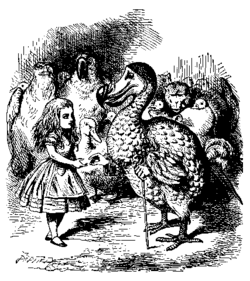
In Lewis Carroll's Alice's Adventures in Wonderland at a certain point in the proceedings a number of characters become wet. In order to dry themselves, the Dodo decided to issue a contest.
Everyone was to run around the lake until they were dry. Nobody cared to measure how far each person had run, nor how long.
When they asked the Dodo who had won, he thought long and hard and then said "Everybody. Everybody has won and all must have prizes."
Now, four leading psychiatric geneticists have made a startling admission.Their 100 year effort has produced nothing but psuedoscientific gibberish.
From this editorial, this group is going high tech and embracing the Human Genome Project! You might consider buying a pair of hip boots. The doo-doo is gonna get very deep out here in a hell of a hurry!
"If you can't dazzle them with brilliance, baffle them with bullshit". (P.T. Barnum)
Vince- - -
Jay Joseph writes:
I would like to quote from a 2007 article from a group of four leading psychiatric geneticists. They actually admit, after more than two (and in some cases three) decades of intense worldwide research, that they have found virtually nothing in the way of replicated gene findings for psychiatric disorders! They do claim that a "few" findings have been replicated, but fail to name them. In fact, I am not aware of any consistently replicated findings. Unfortunately, many leaders of this field feed stories to journalists about supposed gene findings, and these of course end up as sensationalized reports of "gene findings" that are actually never replicated. It's too bad that the sobering assessments these psychiatric genetic researchers share with their colleagues rarely make it into the popular media.
Here is the quote, from a 2007 article by psychiatric geneticists S.V. Faraone , J.W. Smoller, C.N. Pato, P. Sullivan, and M.T. Tsuang:
"It is no secret that our field has published thousands of candidate gene association studies but few replicated findings."
Jay Joseph, Psy.D.
Licensed Psychologist
The Missing Gene (2006), The Gene Illusion (2004)
www.jayjoseph.net
- - -
Vera Hassner Sharav of the Alliance for Human Research Protection comments:
In the 1930s eugenicists proclaimed mental disorders were "proven" to have a genetic basis. Psychiatrist Franz J. Kallmann, an influential geneticist of the period said that the aim of his 1938 schizophrenia family study was "to offer conclusive proof of the inheritance of schizophrenia." [1 See, note]
A major report by Dr. Alan Sanders and 22 colleagues in the official journal of the American Psychiatric Society, acknowledges that the science isn't there to support the claim of a genetic cause for schizophrenia. Their comprehensive analysis casts doubt on the genetic hypothesis for schizophrenia:
"our findings suggest it is unlikely that true associations exist at the population level for the alleles that have formed the basis for the large candidate gene literature for these 14 postulated schizophrenia candidate genes." [2]The sample included 1,870 cases (schizophrenia and schizoaffective disorder) and 2,002 screened comparison subjects (i.e. controls), all of European ancestry, with ancestral outliers excluded based on analysis of ancestry-informative markers.
"Neither experiment-wide nor gene-wide statistical significance was observed in the primary single-SNP analyses or in secondary analyses of haplotypes or of imputed genotypes for additional common HapMap SNPs. Results in SNPs previously reported as associated with schizophrenia were consistent with chance expectation, and four functional polymorphisms...did not produce nominally significant evidence to support previous evidence for association."Psychiatry has so far failed to provide a valid explanation for any biological underlying cause for mental disorders. After decades of research utilizing sophisticated technology, no genetic, biochemical, or other biological locus for psychiatric disorders has been found. The "chemical imbalance" theory has been debunked as a "metaphor," Thus, the presumed biological basis underlying psychiatric diagnoses remains unvalidated. (PlosJournal)
Jay Joseph has written books and numerous journal articles critical of genetic research in psychiatry. He provides a cogent critique of psychiatry's underlying assumptions and flawed methodology. He believes that molecular genetic research in psychiatry has failed to find specific genes that cause psychiatric disorders because such genes are unlikely to exist. [3]
In light of the failure to pinpoint any biological basis for mental disorders, Psychiatry will be hard pressed to justify its continued prescribing of highly toxic drugs whose severe adverse effects are measurable and documented in chronic disability and early deaths.
Psychiatry's aggressive prescribing practices—including prescribing untested multi-drug combinations or "cocktails" even for young children—lack a medico-scientific basis.
Psychiatry's prescribing of antipsychotics singly and in drug cocktails is akin to using a chemical sledgehammer. Lacking a science-based biological target, such a shotgun approach is carried out in complete ignorance.
Four-year old, Rebecca Riley was a casualty of psychiatrists' irresponsible use of toxic drugs for a dubious biological diagnosis at age 28 months.
References:1. Dr. Kallmann trained under Dr. Ernst Rüdin, one of the architects of racial hygiene policies in Nazi Germany, fled to the US in 1933. Kallmann F: The Genetics of Schizophrenia: A Study of Heredity and Reproduction in the Families of 1,087 Schizophrenics. New York, J. J. Augustin, 1938
2. Alan R. Sanders, M.D. + 22 colleagues. No Significant Association of 14 Candidate Genes With Schizophrenia in a Large European Ancestry Sample: Implications for Psychiatric Genetics, Am J Psychiatry 2008; 165:497–506.
3. Jay Joseph's latest book, The Missing Gene: Psychiatry, Heredity, and the
Fruitless Search for Genes, 2006, New York: Algora.
Contact: Vera Hassner Sharav
veracare@ahrp.org
212-595-8974
See also:
Doctor is sued in death of girl, 4
The parents of 4-year-old Rebecca Riley are awaiting trial on charges that they killed her in December 2006 with an overdose of psychiatric drugs.
more stories like thisA medical malpractice suit filed yesterday asserts that a Tufts Medical Center psychiatrist who diagnosed the girl as bipolar when she was 28 months old and then treated her for two years with a regimen of powerful drugs is to blame for her death.
The new neuropsychiatric genetics
It is no secret that our field has published thousands of candidate gene association studies but few replicated findings. (emphasis added) After much discussion among the Editors and the Editorial Board about guidelines for publishing such studies, we have decided to use the following principles to guide our editorial decisions...
"Unlikely" that key genes cause schizophrenia
"We did not detect a significant association of schizophrenia with SNPs in 14 candidate genes that have been of great interest to the field," wrote the authors."Our results suggest that, taken together, common DNA variants in these 14 genes are unlikely to explain a large proportion of the genetic risk for schizophrenia in populations of European ancestry."
posted by Sepp Hasslberger on Thursday March 27 2008
updated on Friday June 26 2009URL of this article:
http://www.newmediaexplorer.org/sepp/2008/03/27/neuropsychiatric_genetics_fails_to_find_cause_of_mental_illness.htm
Related ArticlesPsychopharmacology: Critical Psychiatry
Psychopharmacology or "pharmacology of the soul" is really a contradiction in terms, but then so is psychiatry itself. It is the art of influencing and controlling behavior that we consider socially unacceptable by means of chemicals, yet psychiatry pretends to be a part of medicine, of an effort to help and heal. Sometimes psychiatrists have been called shrinks or head shrinkers. Shrinking heads was a traditional practice of some ferocious... [read more]
January 18, 2008 - Sepp HasslbergerCoercion As Cure: A Critical History Of Psychiatry
This article is based on a recent message by Vince Boehm who sends out alerts, useful news items, and comment to a group of mental health professionals, decision makers and activists. Vince sends out two essays on the nature of psychiatry as practiced today. The first is by eminent psychiatrist, Thomas Szasz, Professor Emeritus of Psychiatry at the State University of New York Health Science Center in Syracuse, New York. ... [read more]
January 14, 2007 - Sepp HasslbergerRoad Rage - Why Tom Cruise was Right About Psychiatry
The controversy over the public remarks of Tom Cruise giving the label of "pseudoscience" to psychiatry in a talk show brings to light a question we do not normally ask: What is the basis of psychiatric diagnosis? Vince Boehm, a psychiatric survivor, who runs an excellent mailing list for those interested in reforming psychiatry so it may one day become a useful part of medicine, has sent out an article... [read more]
June 25, 2006 - Sepp HasslbergerHealing Psychiatry
Ever since the days of Freud, psychiatry has been hostage to the needs of society, rather than serving those of individual patients. Supposedly a healing art, it has instead developed into a tool of social control, removing the points of view that don't fit the paradigm. The bearers of uncomfortable views are labeled "crazy" - they are often incarcerated in institutions, shocked into oblivion or drugged until they forget. Psyched... [read more]
November 07, 2007 - Sepp HasslbergerPsychiatric Drugs - Engineering Children
New Scientist just days ago came out with an article Prescribing of hyperactivity drugs is out of control that discusses the mind boggling figures of child drugging at the hands of psychiatrists in the U.S.A. ADHD is the diagnosis that accounts for close to 4 million prescriptions of mind-altering drugs such as methylphenidate, marketed as Ritalin, to "treat" the "condition". Vera Hassner Sharav of the Alliance for Human Research Protection... [read more]
April 04, 2006 - Sepp HasslbergerBush To Impose Psychiatric Drug Regime
Plans to screen whole US population for mental illness According to a recent article in the British Medical Journal, US president George Bush is to announce a major "mental health" initiative in this coming month of July. The proposal will extend screening and psychiatric medication to kids and grown-ups all over the US, following a pilot scheme of recommended medication practice developed in Texas and already exported to several other... [read more]
June 23, 2004 - Sepp Hasslberger


