




Statins Inhibit Important Biochemical Pathway - Cause Predictable 'Side Effects'
Cholesterol lowering statin drugs such as Lipitor, Crestor, Zocor and Pravachol inhibit a liver enzyme which in turn limits the production of mevalonate, blocking an important biochemical pathway in our normal metabolism. Absence or scarcity of mevalonate as induced by statin drugs leads to numerous side effects, some of them very painful, others involving memory and mental and emotional disposition.
But what's a bit of pain, you might ask, to prevent a heart attack? Sometimes we need to suffer in the name of prevention. The doctor has ordered it. You might be surprised to find out that both the muscle pains and the mental fog you feel are not justified by the positive effects of these drugs. The real preventive potential of lowering your cholesterol is greatly in doubt.
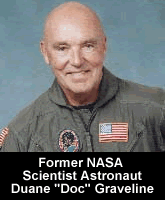
'Spacedoc' Duane Graveline, author of Statin Drugs Side Effects: the misguided war on cholesterol
One doctor, Duane Graveline, a former astronaut and now a major critic of the indiscriminate use of statin drugs (see spacedoc.net) has put together the information on the drugs' side effects. He explains the technical details in a way that someone who isn't a doctor can follow without too much trouble.
But even your doctor might learn something new since the pharmaceutical companies are not very forthcoming with this kind of information. So print out this article and pass it on...
- - -
Statin Drugs and the Mevalonate Pathway
(this article is based on writings of Spacedoc Duane Graveline)
When I first started my investigation into the mechanisms of action of the statin drugs, I was still without prejudice towards the drug companies. I candidly assumed both they and I were on the same course – public health good was our goal. Sad to say I was still naïve then and quite unsophisticated as to how the world really works. Is it Voltaire who wrote the novel Candide? Candide was me and I was happy then.
Now, seven years later I am wiser but cynical with a taste in my mouth that worsens almost daily as I read of corporate and governmental greed. No longer do I find heroes and good deeds. I find that stockholder (voter) loyalty justifies all actions. What is good for our country, state, society, mankind and/or public health are but quaint and noble concepts useful only to guide thinking once stockholder profits are satisfied.
A simple reductase inhibitorLook at Pfizer’s opening paragraph of Lipitor’s description.
“Lipitor is a reductase inhibitor. This enzyme catalzyzes the conversion of HMG-CoA to mevalonate, an early and rate limiting step in cholesterol metabolism. Mevalonate is a precurser of sterols, including cholesterol.”That is it, ladies and gentlemen. That is all they said about mevalonate. They basically admit the statin class of drugs is going to “seriously inhibit mevalonate” in a manner of speaking but never a word about what that really means for the human body! To reduce your cholesterol by 40% is to reduce your mevalonate by 40%. Are you interested in what this really means?
This opening statement is the very beginning of Pfizer’s current program of misrepresentation, deception, prevarication, mendacity and downright lying about their product. And the truly sad thing about all this is that, out of their personal ignorance of our “mevalonate pathway” and their unfortunate susceptibility to the Pied Piper tidings of well-trained drug “reps”, most of our clinicians believe this obfuscation from the drug company and are enthusiastically aiding and abetting Big Pharma in its sales drive.
Inhibiting Coenzyme Q 10The drug companies knew from the very beginning that CoQ10 would be inhibited, just like cholesterol. Merck even filed a patent for a CoQ10/statin combined pill.
Canada advised CoQ10 co-administration with statins from the very beginning of marketing back in 1990. Were Canada’s governmental and corporate officials more informed than those of the United States? No, just more compassionate, while ours were being unduly influenced by the possible negative effect on marketing of a combined pill or of recommendations for CoQ10 supplementation.
This was the beginning of the sour taste in my mouth. CoQ10 depletion has been the cause of many thousands of side effects, especially the neuropathies, myopathies and rhabdomyolysis cases. Some of these cases have been fatal. Many have resulted in chronic disabilities.
Glycoprotein synthesis and dolicholsThe next branch on the mevalonate pathway tree to suffer inevitable depletion from statins was the production of dolichols, vital to the synthesis of glycoproteins, and the attachment of sugars necessary for cell identification, cell messaging, neuropeptide synthesis and immunodefense. This is all on my website (see spacedoc.net).
Just pick up a copy of any medical school biochemistry text for a review of glycoprotein synthesis and dolichol’s prominent role. Although taught this as freshmen, most doctors have forgotten long ago the complex interplay of sugars and proteins, orchestrated by dolichols.
No, I have to admit, when I first heard of statin’s effect on our mevalonate pathway, I did not review the subject in my old chemistry book. I just accepted the words of the drug industry to do right. You have to have some faith, don’t you? It hurts when your faith fails you.
Phosphorylation and the tau proteinThe next branch of the mevalonate tree to suffer from statin effect is our normal phosphorylation process resulting in both tau protein enhancement and inhibition of embryonic stem cell self-renewal. No I am not making this up. It comes right out of our current research literature. Sure it’s on mice. We’re guinea pigs aren’t we? That makes us close.
I do not wish to elaborate on the consequences of this but will remind you that just two months ago the World Health Organization reported excess ALS among statin users worldwide. Did you know that tau protein is the stuff of neurofibrillatory tangles and it’s not just in Alzheimers any more? And the mevalonate tree still has selenoprotein branches, Rho (the memory catalyst) and many others.
Drug companies to blameShould I be the one to advise the pharmaceutical industry that they should not intentionally block our mevalonate pathway? In so doing they have created a nation of guinea pigs, an entire population devoted to seeing what would happen. And blocking our glial cell cholesterol production was more of the same thing. Despite Pfrieger’s publishing of the mechanism by which our statin drugs inhibit memory only five years ago, have we seen the slightest recognition of culpability by FDA or the drug industry? You got it – not a word!
I am appalled that organizations I once regarded as sharing a pedestal with God and motherhood, behave in such a callous manner. My deep respect has been forever shattered.
The guinea pig clubThe statin guinea pig club is you, especially you who have been touched by the side effects of statins!
Day by day we are learning the true effects of statin drugs on our mevalonate pathways. Things the statin drug manufacturers should have known long before they requested FDA approval. But you must remember that back when these drugs were first coming to market, cholesterol was public health enemy number one and these cholesterol inhibitors were high priority.
Very few questions were asked by an agency concerned more with rapid approval than picky questions. Anything that would lower cholesterol was a friend of man, no questions asked. Obviously the research scientists knew they were in uncharted water and quite possibly they made their questions and anxieties known to management but in this cost plus effectiveness sparring that took place in the back rooms, research clearly lost to management pressure. Billions of dollars were at stake.
I am not going to tell you these research scientists did not know what was going to happen. Of course they knew the importance of the mevalonate pathway. Of course they knew that blocking this pathway at its very origin was bound to have serious complications. This was their job, their training and their life but they were over-ridden. Billions of dollars create a great deal of pressure, sweetened only by the presumption that if you lower cholesterol 1% you would add 2 years to life. How many times did I hear that in the days of the Framingham study.
The anti-cholesterol bandwagon needed the statins badly and whatever safeguards we had proved to be very flexible. One might say the almighty noise of the bandwagon drowned out the voices of caution and reason. Only in the past decade did the noise of the bandwagon diminish sufficiently to let truths begin to emerge.
The truth will outThe first thing that happened was that the consequences of CoQ10 inhibition gradually leaked out (see spacedoc.net). A major part of our mevalonate pathway is directed at CoQ10 synthesis. As a consequence, CoQ10 plummets after statins are started and we found patient after patient with muscle damage, rhabdomyolysis, neuropathy, congestive heart failure and serious fatigue all related one way or another to lack of CoQ10. Supplementation of CoQ10 started usually at the patient’s insistence, not the doctor’s.
The next important event was Frank Pfreiger’s astounding revelation in 2003 of the importance of cholesterol to brain function. Our brain’s synapses cannot function without sufficient cholesterol and since the LDL/cholesterol molecule is much too large to pass the blood/brain/barrier, nature had devised an alternative means of manufacture - the housekeeping cells of the brain, known as glial cells. Of course, these glial cells were extremely sensitive to statin’s touch and finally in 2003 we had an explanation for our amnesia, forgetfulness, confusion and disorientation.
Meanwhile the statins had been on the market for 15 years and these almost inevitable cognitive side effects were being overlooked by thousand of physicians. “You’re getting older,” or, “perhaps a touch of Alzheimers?” was the prevailing excuse for this terrible oversight. And the hundreds of cases of the elderly passing in dementia shortly after statins were started “for their health” might best be left buried.
Then, only two years ago did we learn of the close association of statin therapy with aggression, hostility, irritability, homicidal ideation, depression and suicides and only then did we know that the likely mechanism of action was our dolichols, which bear the entire responsibility for overseeing our neuropeptide synthesis function. Every thought, every sensation and every emotion you have ever had originates with the synthesis of a specific neuropeptide chain. Dolichols are collaterally damaged by statins, just like CoQ10.
By now, statins had been on the market for 18 years and patient claims of bizarre thoughts and actions during this time had been swept under the carpet as emotional by the unsuspecting physicians and their patients referred to psychiatry.
And there is more, much more. On the basis of my six years of research I could talk seleno-protein inhibition, tau protein synthesis and other new pathways of statins' broad reach but I have made my point. We have all been guinea pigs. Welcome to the club!
Cholesterol is irrelevantBut there is one more observation that I saved for the end - the piece de resistance. The fact that now we have learned that cholesterol is irrelevant to the atherosclerotic process. Inflammation is the cause and statins work because they are powerful suppressors of inflammation. Cholesterol, the reason the statins were developed in the first place, is not public health enemy number One. It is probably our closest biochemical friend.
Our research scientists were completely ignorant of this anti-inflammatory aspect to statin drugs. This was just some magnificent bit of serendipity. Medicine needs this effect but not at the cost of our mevalonate pathway.
Please print this out and give it to your doctor. Every word is documented.
Statins can't stand the truth!I am not an enemy of statin drugs. Statins do work to reduce cardiovascular risk. Why then this absurd title? Years ago I would not have considered statins to be any other than the best tool we had for cholesterol reduction. That was back in the days when all of us were taught that cholesterol was our enemy and statins worked their reductase inhibition magic by blocking cholesterol synthesis.
In retrospect I was blissfully ignorant but happy and fulfilled as a doctor. I recommended the low fat/low cholesterol diet to my patients, raised my family on skim milk, no eggs and margarine instead of butter, talked at service clubs of the evils of eggs and butter and must have written 10,000 prescriptions for whatever cholesterol buster was in vogue at the time. Statins were a boon to treatment of this new disease called high cholesterol.
Then came the first hints of a new reality. Statins worked in many cases even when cholesterol remained unchanged.Then our longitudinal studies reported that statins worked independently of cholesterol reduction.
Then we learned that statins are powerful anti-inflammatory agents working by the previously unheard of mechanism of nuclear factor kappa B inhibition, affecting a transcriptase common to our entire immunodefense system.
The we learned that atherosclerosis was an inflammatory disease, an endothelial reaction triggered by such factor as homocysteine, transfats, omega 6 excess, oxycholesterol, inherited platelet and coagulation factors and occult infections. Cholesterol was not even on this list!
Natural cholesterol was our friend – you can’t live without an abundant supply of it. Only when exposed to oxygen and converted to oxycholesterol did it become the toxic substance that blocked rabbit arteries with such ease. Please remember that oxycholesterol is in the dried milk and eggs now used in hundreds of pastries and cookies lining our grocery shelves. Did you really think they would be using fresh eggs and milk?
For four decades we have been taught that cholesterol was our enemy. Now we find that we cannot live without it. Now we doctors must adapt to this new schizoid reality where black is white and white is black. For years we have been dosing our statins in cholesterol lowering amounts. Now we must ask ourselves why.Then we begrudgingly learned that our statins were far more than simple reductase inhibitors – whatever that means. Then a few of us took up our dusty biochemistry books and learned that to be a reductase inhibitor means to block our mevalonate pathway to varying degrees of complete (see spacedoc.net).
So statins inevitably block our CoQ10, dolichols, normal phosphorylation, selenoprotein and a new substance to most of us – Rho, the essence of memory synapse formation – all using this same mevalonate pathway for their own purposes.
Dosing statins at cholesterol lowering levels not only makes no sense but it is the direct cause of all of our many side effects. Read my Medwatch Review of Lipitor (1998-2007) for the disgraceful side effect profile, made all the more shameful because of lack of FDA feedback of these problems back to our doctors.
What have we done? How did we let this happen?Our statins are effective but now it appears that our cholesterol lowering doses are the reason for our mevalonate blockade with its unacceptable side effects.
Far smaller statin doses will provide excellent anti-inflammatory benefit with negligible risk of side effects. Yes, this reality is not easy for our brains to assimilate after four decades of brainwashing.
But this is the new truth.
Duane Graveline MD MPH
spacedoc.net
© Duane Graveline
See also:First comprehensive paper on statins' adverse effects released
"Muscle problems are the best known of statin drugs' adverse side effects," said Golomb. "But cognitive problems and peripheral neuropathy, or pain or numbness in the extremities like fingers and toes, are also widely reported." A spectrum of other problems, ranging from blood glucose elevations to tendon problems, can also occur as side effects from statins.
posted by Sepp Hasslberger on Monday March 17 2008
updated on Friday October 15 2010URL of this article:
http://www.newmediaexplorer.org/sepp/2008/03/17/statins_inhibit_important_biochemical_pathway_cause_predictable_side_effects.htm
Related ArticlesCholesterol - what a business plan
When cholesterol was identified as health-enemy number one, we switched from butter to margarine and did without eggs for years, in an effort to avoid falling prey to the oily killer. At the same time, a whole pharmaceutical product sector, accounting for revenues in the $ billions, magically appeared to sell us pills. The sales pitch was: "Protect your heart - lower your cholesterol" or any variation of that mantra.... [read more]
October 17, 2003 - Sepp HasslbergerStatin Drugs Cause Amnesia, Behavioral Disorders and Cognitive Loss
Duane Graveline, a former astronaut and medical doctor is one of the few 'lone voices' warning of the side effects of statin drug use. His website spacedoc.net probably has more information on statin drug side effects than any other place on the internet. Duane 'Spacedoc' Graveline, author of Statin Drugs Side Effects: the misguided war on cholesterol Doc Graveline has now released some more of his research into the side... [read more]
August 14, 2007 - Sepp HasslbergerStatins May Scramble Memory
Adding to the long list of side effects of statin drugs, a charge was made by Dr. Golomb that statins may "hamper the brain's performance and trigger other serious problems." She is leading an independent clinical trial to find out what harm statins may be doing. CBS talks of "mind boggling effects" of the statin drugs and relates the story of Jim Matthews, who found himself reeling "struck by cognitive... [read more]
May 25, 2004 - Sepp HasslbergerBig Pharma's Cholesterol Roulette - Statins and Glyconutrients
Statin drugs are some of the most damaging medicines ever invented, but the situation is especially grave because statins - they go under names such as Lipitor, Mevacor, Pravachol, Crestor and Zocor - are officially recommended by the highest health authorities as a "preventive" measure for heart attacks. The Cholesterol Molecule - Image credit: World of Molecules. These drugs are highly inefficient in what they are advertised to do. As... [read more]
May 15, 2007 - Sepp HasslbergerLipitor: Side Effects And Natural Remedy
Serious side effects have been reported for Lipitor and other cholesterol-lowering drugs - the so-called statins - prescribed to millions for preventive purposes. The prescription of these drugs is based on the discredited hypothesis that high cholesterol levels cause heart attacks. The cholesterol myth has been one of the most long lived falsehoods around - probably because it has been excellent business, both for large pharma producers as well as... [read more]
March 18, 2004 - Sepp HasslbergerLipitor - The Human Cost
Lipitor, a cholesterol lowering drug made by Pfizer and sold to millions of health conscious but ill informed patients, is one of the most profitable drugs the pharmaceutical industry has ever come up with. Sales account for a quarter of Pfizer's $ 32 billion annual sales. Expected to gross more than $ 10 billion this year, Lipitor is poised to become the largest-selling pharmaceutical in history, surpassing Pfizer's other wonder... [read more]
January 31, 2004 - Sepp Hasslberger


