




Kava Kava - Germany, UK To Review Ban

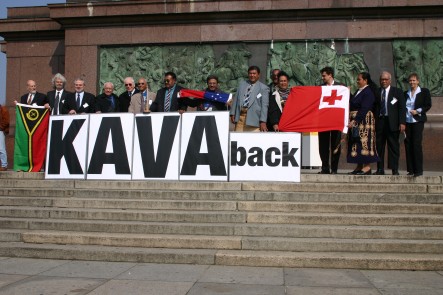
Kava protest - Victory Column (Siegessäule) in Berlin
Kava Kava, a calming and relaxing herbal preparation traditionally used in several South Sea islands, made from the roots of piper methysticum, was taken off the market in several countries on the strength of "safety concerns". Canada banned the herb in 2000, Germany in 2001 and several other European countries followed suit, although the evidence of actual harm to people's health has always been extremely tenuous.
As a natural relaxant, Kava was heavily intruding on the turf of several big selling pharmaceutical antidepressants such as Prozac, Paxil, Zoloft, Luvox, Serzone and Effexor, of the selective serotonin reuptake inhibitor (SSRIs) family. Generally, pharmaceutical companies do not take kindly to competition, especially from outsiders such as natural remedies. National health authorities are known for their close relation with the pharma giants and normally oblige if the "experts" say that something is dangerous for health and needs to be removed from the market. That is in fact what happened to Kava Kava.
Never mind that the herb has a tradition going back three millennia and has never been known to cause any serious health problems, never mind that several island nations lost much of their export crop to this tussle between pharma's antidepressants and their natural cousins.
In December last year, Wales rescinded its ban on Kava on a technical point, however a legal action mounted by the National Association of Health Stores to overturn the ban in all of the UK, was not successful.
The major Kava-producing nations of Fiji, Samoa, Tonga and Vanuatu and European interest groups have formed the International Kava Executive Council to set matters right. The World Health Organization decided in October last year to undertake a review of the safety of Kava. More recent meetings held between the Kava producers and national health authorities in Berlin and London seem to have brought a breakthrough towards a possible solution.
International Kava Executive Council in Berlin and London March 31 through April 3, 2004
Kava: Breakthrough in Germany
A breakthrough was achieved in the German debate on the reversal of the highly disputed kava ban, at the Berlin Meeting of the International Kava Executive Council and the German Health Ministry.
Kava is an herbal preparation obtained from the rootstock of the plant Piper methysticum originating from the South Pacific Islands. Due to its remarkable calming and muscle relaxing effects, it is used in food supplements and herbal medicines worldwide. In 2002 its sale was prohibited in a number of countries after adverse effects were reported that were thought to be related to the intake of kava products. These measures were highly criticized within the scientific community who thought that the bans were a disproportionate response to the size of the alleged problem.
European Herbalists and the South Sea Producers protest against the kava ban in Berlin
On April 1st, in Berlin, a delegation from the Pacific, headed by the Ambassadors of Fiji and Samoa, met with the German Deputy Health Minister Dr. Klaus Theo Schroeder for talks on the kava ban. Together with scientists, practitioners and representatives of the “International Kava Executive Council” (IKEC), the delegation discussed the requirements that will have to be met in order for kava to be made available again for patients suffering from stress, restlessness and mild degrees of anxiety. In the constructive discussions, it was agreed that further research activities would focus on the safety of kava first, before discussing its efficacy. Whilst in Germany, the question of efficacy of kava is a major part of the debate this is of less importance in other countries where it was not available on a doctor’s prescription and where the decisions to withdraw the products from the market were based on safety alone.
All participants have been in complete agreement that it will be possible, and there was a commitment, to re-evaluate the safety of kava within the next six months. Deputy Health Minister Dr. Schroeder, therefore, called on representatives of the German Health Ministry, the IKEC and independent experts in the fields of pharmacology and toxicology to come together to determine the appropriate design for the generation of new data.
Dr. Joerg Gruenwald, Executive Director of the IKEC, who organized the meeting in Berlin, is confident that this data will confirm the results of other studies and show that kava is a safe herbal, commenting: “Now we finally have the opportunity to prove the safety of kava conclusively.”
The results of the toxicological research being proposed, may also contribute to the kava safety evaluations in other countries where kava is currently prohibited or under debate. This was concluded in a meeting of the delegation with the UK Medicines and Healthcare Products Regulatory Agency (MHRA) that took place on April 2nd in London. In these talks the MHRA expressed considerable interest in the German approach to creating new data, and advised that the Agency welcomed a dialogue on this issue and will consider the results of all new research.
These talks were only one part of a broad program of action that was organized by IKEC on behalf of the kava producing Pacific Islands States that are currently suffering from the drastic socio-economic consequences of the kava ban. Tau’ili’ili U’ili Meredith, Ambassador of Samoa to Europe explained that: “The Pacific States have lost about 25 % of their Gross National Product and a growing and promising Industry in the Pacific was destroyed nearly overnight, not to speak of the loss of an important herb to European consumers, a herb widely used for the treatment of stress and anxiety”.
Both meetings and the activities of IKEC are sponsored by the international organizations CDE and PRO€INVEST, and the companies Aboca, Specchiasol, Ulrich from Italy and Finzelberg from Germany.
For further information you may contact:Dr. Joerg Gruenwald
Executive Director IKEC
International Kava Executive Council
Direct: +49 173-2500396
See also:http://www.kavafriends.org/
The site is still under construction, but has both German and English text.Cropwatch: Kava-kava: Bans to be Reconsidered
VANUATU: Heading Up Lobby On International Kava Standards
Friday: May 26, 2006
Vanuatu kava stakeholders have unanimously agreed to lead the lobby for improved quality of the product, locally and internationally, Port Vila Presse reports. This is based on the many kava varieties in Vanuatu compared to Fiji, Tonga, Papua New Guinea and the French territory of Wallis and Futuna. At a meeting in Port Vila, organised by the department of quarantine, it was explained to kava traders that it was now time to introduce kava on the Codex Alimentarus rules.
posted by Sepp Hasslberger on Wednesday April 7 2004
updated on Wednesday December 8 2010URL of this article:
http://www.newmediaexplorer.org/sepp/2004/04/07/kava_kava_germany_uk_to_review_ban.htm
Related ArticlesWHO to Investigate Ban on Kava Herb
Recently, the National Assembly of Wales voted to reverse a ban on the sale of a herb (Kava Kava), a root with relaxing, anti-depressive properties, which had been banned in serveral European and some non-European countries after adverse reaction reports linked the herb to some cases of liver damage. Apparently, the evidence proving the links was never fully made available and has been challenged by the sellers of the herb.... [read more]
December 05, 2003 - Sepp HasslbergerKava regains shelf space in Wales
Kava regains shelf space in Wales 28/11/2003 The kava industry is hoping to see other UK regions follow the move by the Wales National Assembly, which came into effect from the end of October, and will allow kava to go back on sale to consumers. Kava was banned in the UK in December last year because it had been linked to cases of liver damage. It is also banned in... [read more]
December 01, 2003 - Chris GuptaWales Reverses Kava Ban
The National Assembly of Wales as a result of a case brought by the UK's National Association of Health Stores, has reversed a two-year ban on the sale of herbal products containing Kava Kava. The decision came into effect at the end of October 2003. Kava Kava, a root traditionally used to prepare a relaxing drink in South Sea island cultures, had become a widely used alternative to pharmaceutical anti-depressants... [read more]
December 01, 2003 - Sepp HasslbergerKava Court Challenge Unsuccessful - London High Court rejects review
As reported in The Times on 10 January, the case brought by the the UK National Association of Health Stores and actress Jenny Seagrove to force government re-consideration of a ban on Kava Kava was rejected by High Court Justice Crane. A traditional South Sea calming drink is made by fermentation from Kava Kava root and has been used for centuries on several of the South Sea Islands. It is... [read more]
January 12, 2004 - Sepp HasslbergerPaxil, Zoloft, Xantax - Drug Induced Violence
23 August 2004 - The New York Times reports on the Murder case of Christopher Pittman coming up for trial. The 12-year-old has shot his grandparents and put their house on fire, but he says it was the effect of the drug he was on at the time - the antidepressant Zoloft. The case comes amid widespread allegations that antidepressant drugs cause many to commit suicide, a charge hotly denied... [read more]
August 26, 2004 - Sepp HasslbergerEuropean Directive on Medicinal Herbs Discriminates Against China, India, Other Cultures
On 31 March 2004, the European Union put the finishing touches on its directive for herbal medicinal products, which was published in the official journal and can be downloaded as a pdf here. The directive will have to be transformed into national law by the 25 EU member countries. It introduces a simplified registration for herbal medicinal products that have been on the market in Europe for at least 30... [read more]
July 19, 2004 - Sepp Hasslberger


